Maria Sharapova knew a lot more than tennis by the time Shark Tank invited her into the Tank. Years of sponsorships had put her around big consumer brands, and she had also started building a business career away from the court. But sports were still a huge part of it. Maria had spent most of her life training and eventually won five Grand Slam singles titles.
Then the only company she invested in on Shark Tank happened to make weights you wear while exercising. Natalie Holloway and Max Kislevitz had created Bala Bangles for the wrists and ankles. They were not ordinary gym weights either. Bala made them stylish enough to wear around the wrists or ankles while exercising.
Maria had spent years using fitness products as a professional athlete, and she also knew what it was like to work with consumer brands. Maria joined Mark Cuban for the investment. Together, they agreed to give Bala Bangles $900,000 for 30% equity. That is the complete deal though, not Maria’s amount by herself.
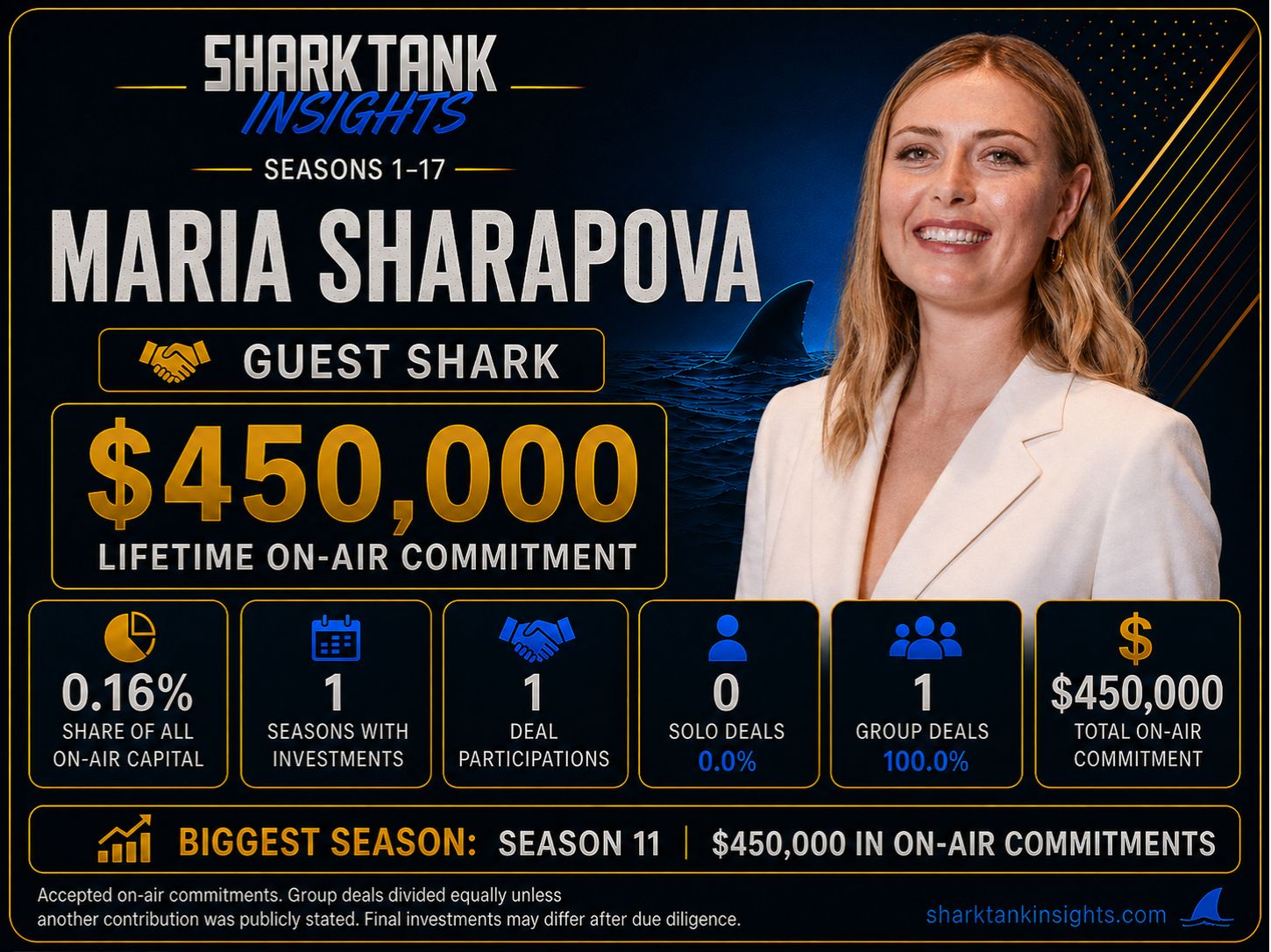
Her attributed half comes to $450,000. Maria never got the chance to build a long list of Shark Tank investments. Episode 13 of Shark Tank Season 11 was her only appearance, and Bala was the only company she invested in. She did not return in another season. One appearance and one accepted deal was her complete run as a Shark.
How Much Did Maria Sharapova Invest on Shark Tank?
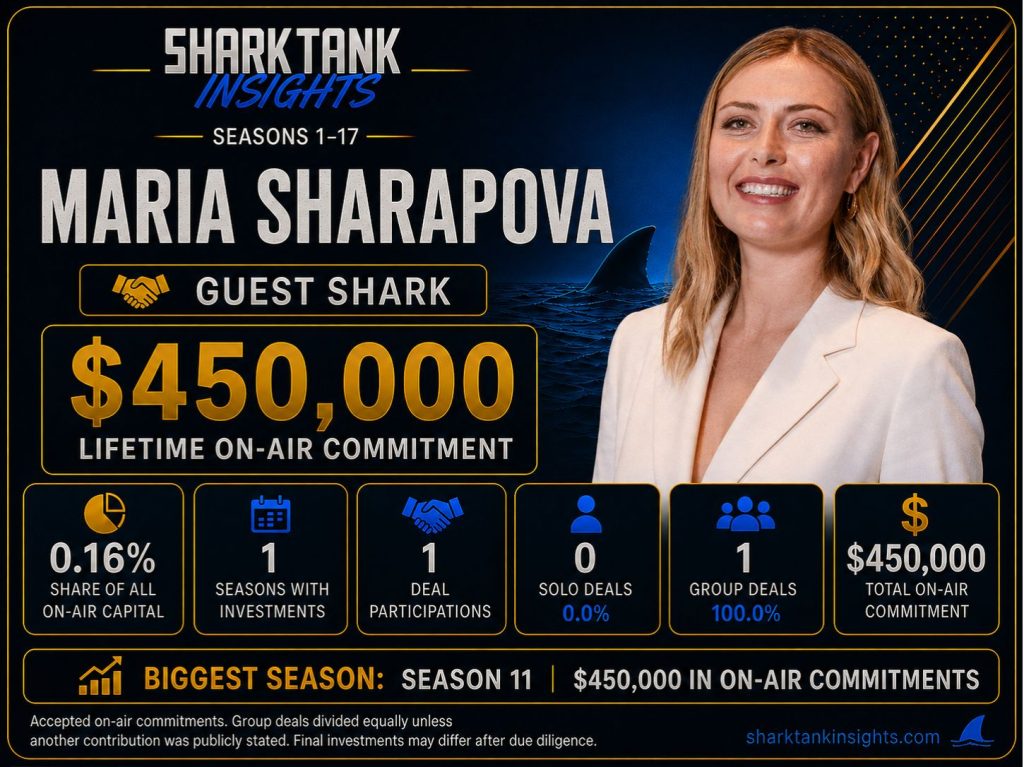
Maria did not have any investment where she was the only Shark putting up the money. Her $450,000 came from Bala Bangles, and Mark Cuban was in that deal with her. The two agreed to $900,000 for 30% of the company. Maria’s half of the investment comes to $450,000.
And that was all of her Shark Tank money. There was no smaller deal before Bala or another company afterward adding something more to the number. Maria made one accepted deal during her one appearance. That makes the $450,000 pretty easy to trace back to one business.
The money is only one part of what Maria and Mark agreed to though. Natalie Holloway and Max Kislevitz gave up 30% for the $900,000, which means Maria is attributed 15% when the deal is divided equally between the two Sharks. Natalie and Max had originally entered asking for $400,000 for 10%. They ended up taking more than twice the money they came looking for.
Maria and Mark did not disappear from Bala once filming was over. Later updates showed them spending time with Natalie and Max as investors in the company. That gives us much more than the original agreement viewers saw on Shark Tank. The exact deal they ended up with is another matter because those final terms were never made public.
Maria Sharapova Invested $450,000 in Bala Bangles
Natalie Holloway and Max Kislevitz needed $400,000 for Bala Bangles. The money would help them keep enough inventory around and put more into marketing. In return, they were offering 10% of the company. That put their business at a $4 million valuation.
Maria was interested, but she wanted another Shark with her. She offered to put in $200,000 for 15% if somebody else would put up another $200,000 for the other 15%. That would give Natalie and Max the $400,000 they came for, although they would be giving away 30% instead of 10%. Daymond John and Lori Greiner were interested too.
But Natalie and Max were willing to take more money if two Sharks came together. They were ready to give up 30% for $900,000, with each Shark putting in $450,000. Maria and Mark Cuban went for it. The founders accepted the $900,000 deal.
That was more than twice the $400,000 Natalie and Max had originally come looking for. It also brought Bala’s valuation down from $4 million to about $3 million. But the founders now had another $500,000 to work with, along with two Sharks instead of one. Maria’s side of that final agreement was $450,000 for an attributed 15% of Bala.
What Happened to Bala Bangles After Shark Tank?
Bala got a very lucky time for selling exercise equipment. Not long after its Shark Tank appearance, the pandemic had people doing much more of their exercising at home. Bala reportedly made millions of dollars in sales as the demand for home fitness products went up. That gave Bala a much bigger group of people to sell to.
Bala did not stop with the weights Natalie Holloway and Max Kislevitz brought into the Tank either. They added other weights, fitness accessories and apparel, while the business also made its way into major retail. There was a lot more to Bala now than the Bangles Maria Sharapova had originally invested in.
Maria Sharapova After Shark Tank
Shark Tank came right near the end of Maria Sharapova’s tennis career. She retired from professional tennis in February 2020, after spending almost two decades playing professionally. But there was still another side of her career that had already started before tennis ended.
Sugarpova had been around for years by then. Maria was not only putting her name on somebody else’s product either; she had her own company and was learning the product side of a business. Then there were investments outside Shark Tank as well, including companies such as Supergoop and Therabody.
That part kept going after she stopped playing tennis. Maria had spent years earning money from sponsorships and working with large brands, but now she was also putting her own money into businesses. It was a different place for her to be after so many years as the athlete companies wanted to sponsor. Shark Tank happened somewhere around that change in her career.
Conclusion
Maria Sharapova did not spend much time on Shark Tank. One episode gave her one company, and there was never another deal after Bala Bangles. Her part of the $900,000 agreement with Mark Cuban comes to $450,000. That is the complete amount attributed to Maria from her time in the Tank.
Bala at least gives us more to go on after the cameras stopped. Maria continued to be seen with the founders as an investor, and Bala went on to sell millions of dollars of products and become a much bigger fitness company. What Maria got back from her $450,000 is something we do not know. Nobody has made her actual return public.

Hi. I’m Daniyal Durrani. A CA-finalist, CPA-UK, and Master in Economics, with a decade-long business studies experience. I work as an Audit and Business Advisory Manager in a globally recognized accounting firm. I have been watching Shark Tank for a long time and have always admired the innovative business ideas. The revolutionary solutions to unaddressed day-to-day problems presented on the show used to impress me like no other thing on TV. Read more About me.