
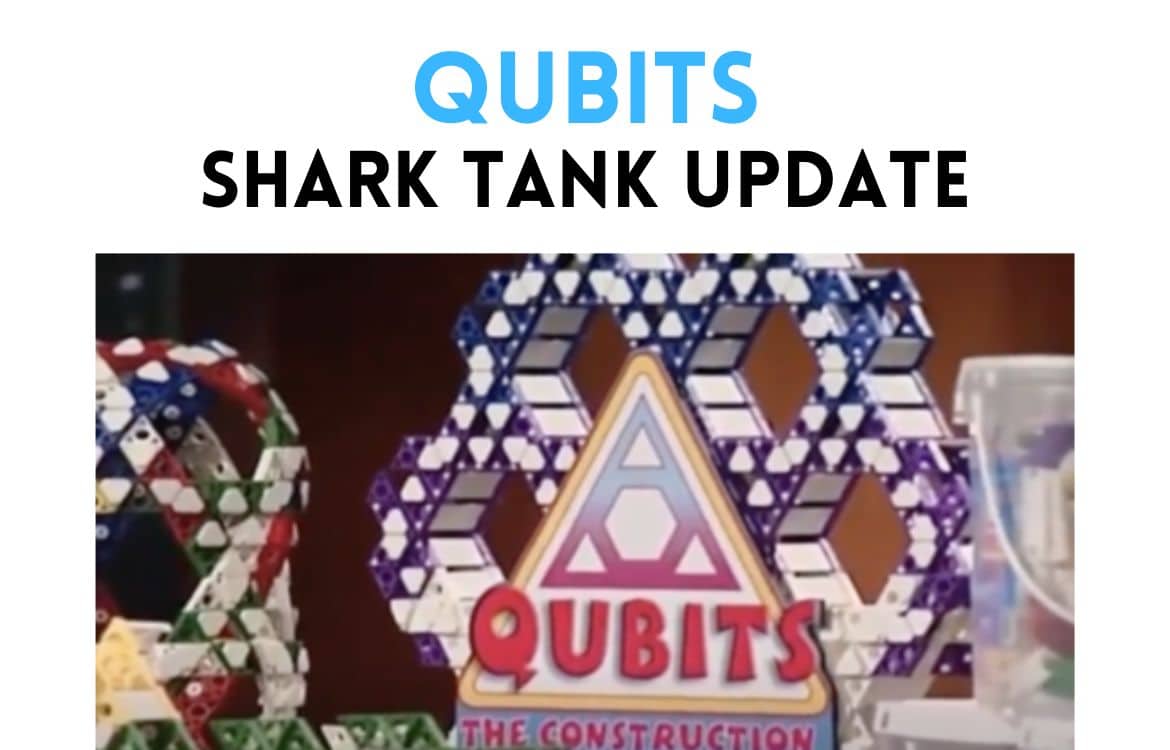

Mark Burginger came on Shark Tank with his innovative toy manufacturing company. He mentioned that his only goal was to introduce a new concept for children to experience different types of building blocks, which enhance their creativity and help them learn how to solve problems with 3D experiences.
Mark wanted to give children the freedom to experiment with shapes and curves and create different designs based on the real world. Traditional building toys have limited freedom, which only allows them to form square and rectangular structures.
That’s why he introduced Qubits, which allows children to connect different pieces and form different varieties of 3D structures.
Mark appeared on Shark Tank seeking $900,000 for 51% equity in his company. Here we will discuss the pricing, sales, margin rate, and profitability, and whether they secured the deal or not.
Qubits Net Worth
Mark Burginger went on Shark Tank asking for $90,000 for 51% of Qubits. This meant he valued the company at about $176,471. He accepted an on-screen conditional deal with Daymond John for $90,000 in exchange for 51% of the company. That deal kept the company valuation at about $176,471. The episode aired on February 5, 2010. The deal with Daymond did not close, but Qubits continued operating and later worked with Discovery Toys, whose special Qubits kits sold out within 11 months. Qubits is still active and continues to sell STEM building kits through its official website, with recent estimates placing its yearly revenue at around $1 million. Based on its continued business activity and estimated revenue, the current net worth of Qubits is estimated to be around $4 million as of 2026.
Did Qubits Get a Deal on Shark Tank?
Yes, Mark got the deal from Daymond John, but later they did not partner together. This was a phase of his life when he needed financial help so he could support his passion and company. That’s why he was seeking $90,000 for 51%.
His motive was simple: to give freedom to the children so they can enhance their creativity and learn how to solve problems in the real world. Traditional building toys only offer limited shapes, which limit their creativity.
The Sharks were concerned about certain aspects, but Daymond saw the potential in the products because they could be helpful for the future generation and work as an investment. That’s why he gave them an offer, but only on one condition: that Mark had to secure a deal with a major toy manufacturer.
On air, Mark accepted it, but later found it difficult. Neither the founder nor Daymond established a suitable toy manufacturing company, so that’s why they did not stay together longer. And both parties backed off.
Qubits Shark Tank Deal Table
| Shark’s name | Offer | Accepted |
|---|---|---|
| Daymond John | $90,000 for 51% equity, conditional on a manufacturing deal | Accepted on air, but not finalized |
| Robert Herjavec | Out | No |
| Barbara Corcoran | Out | No |
| Kevin Harrington | Out | No |
| Kevin O’Leary | Out | No |
Founder’s Backstory
Mark Burginger introduced the great combination of technical skills with entrepreneurship experience in the form of Qubits. Before launching his company, he worked in the United States Air Force and architecture.
Because of his interest in technology and design, he helped introduce this innovative concept or idea, which has the potential to turn into a great business.
Through Qubits, children learn how to connect different pieces at different angles and form 3D structures, which is limited in traditional toy-building companies.
It has never been an easy deal because he has to work on manufacturing pieces and inventory work. Qubits has something unique, which attracts customers.
That is why he appeared on Shark Tank in search of an investor who would help him overcome all the challenges. And when Daymond offered him a deal, Mark saw this as an opportunity for growth, but because of manufacturing conditions, things went in different directions than he thought.
Qubits Shark Tank Pitch
Mark entered Shark Tank and started his pitch by highlighting the difference between traditional and Qubits building toys.
He mentioned that his company offered 3D structures with different pieces that connect at different angles to give curves and geometric shapes.
He designed this product to support creativity and enhance the problem-solving ability of children and spatial reasoning. They experiment with shapes and learn how different shapes fit at different angles.
Qubits stands out in the educational toy market because of unique features. With all these features, he got the deal, but because of manufacturing conditions, the deal fell through.
Shark Questions, Negotiations, and Reactions
To understand the product and branding, the Sharks started asking several questions:
Barbara Corcoran wanted to know about the model of the product. Mark replied that it’s flexible geometric pieces connected at different angles. Even though at the start she showed interest, she ended up saying no.
Robert Herjavec asked why he wanted to give away 51% of his company shares. Mark explained that he wanted to support his company, but right now he is not financially strong enough to support it; with the help of the Sharks, he could improve its branding and quality.
Kevin O’Leary questioned the sales. Mark replied that right now they have sales of approximately $8,000, which did not impress him.
Kevin Harrington asked about the competition with other toy-building companies. Mark mentioned that he would partner with other toy manufacturing and distribution companies on a large scale. This plan did not satisfy Kevin.
Why Some Sharks Said No
The Sharks said no to the deal because of those concerns:
Qubits has to compete with other well-known toy-building companies. The Sharks were concerned that the company has to deal with larger manufacturers to meet consistent quality and reliable suppliers.
The product needs great marketing and strategy because an innovative product still needs proper planning to reach out to the specific audience.
The Sharks were satisfied that their sales could not compete on larger scales because everything about their product was so confusing. No doubt their product was amazing, but it needs proper planning and strategies to become a well-known brand.
Even though Daymond saw the potential in Qubits, his offer came with the condition of requiring a manufacturing agreement, which became difficult for Mark to fulfill.
For all these reasons, the Sharks said no because of all these concerns.
Where to Buy Qubits and Product Features
Customers can buy Qubits from their official website, the official Qubits Toy website. On their website, they listed several products like educational material, bulk kits, and construction kits for classroom use. These prices and availability change over time.
Qubits has unique features like:
- Flexibility, which can be fixed in different shapes and allows three-dimensional structures.
- Has geometric styles rather than the square and rectangular shapes from traditional toy-building companies.
- Helps children to learn problem-solving and spatial reasoning and do experiments with shapes. In addition, Qubits provides a free 60-page educational eBook.
What Happened to Qubits After Shark Tank?
Qubits continued operating after the deal with Daymond John fell through. After their appearance on Shark Tank, Qubits got global recognition, which increased their sales and helped them reach an international audience. Their biggest achievement was their partnership with Discovery Toys.
Mark demonstrated that Discovery Toys placed special orders for Qubits kits, which rapidly sold out within 11 months. And their product became the best-selling product of Discovery Toys.
With this partnership, Qubits got the authority to distribute through channels focused on both educational and personal purposes. As of now, they are still actively launching their new products and working on different strategies for the company’s sake.
Conclusion
Mark Burginger has a unique idea, but because of a lack of strategies and planning, they did not receive deals from the Sharks.
Qubits offered a healthy alternative to traditional building toys, which allows more shapes and flexibility to learn experimentation, learn problem-solving, and develop spatial reasoning.
Mark asked for $900,000 for 51% of equity, and this deal was accepted by Daymond, but on one condition: Mark had to deal with the manufacturer for high-scale production.
Because Mark needed financial support at that time, he found it difficult to fulfill; that’s why the deal could not proceed after the show. But he got new opportunities to embrace his brand, like a partnership with Discovery Toys, which became the turning point of his company.
Qubits shows that a failed Shark Tank deal does not mean you have failed. Sometimes failure diverts you toward the right path, so stay connected to know about their future aspects.