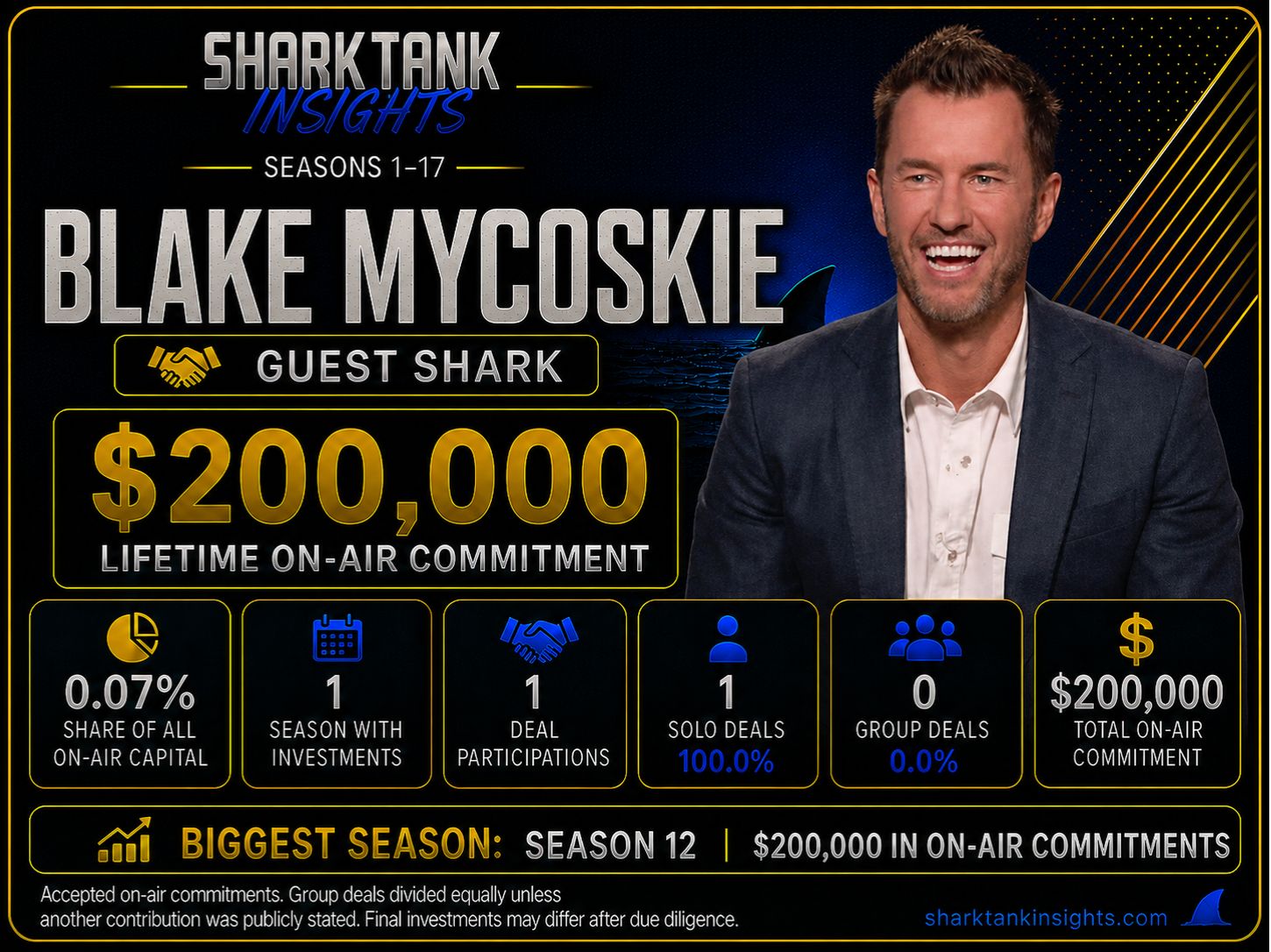
Blake Mycoskie appeared on Shark Tank Season 12 as a guest Shark with years of business experience behind him. The entrepreneur was already popular for creating TOMS, a shoe company that became famous for its One for One business model. Moreover, Blake had invested in several companies through his Social Entrepreneurship Fund before entering the Tank.
However, Blake did not go on an investment spree during Shark Tank. He invested in just one company throughout his appearance on the show. The lucky business was Touch Up Cup, founded by the father-son duo Jason and Carson Grill. Did Blake’s only Shark Tank investment turn into a successful business? Keep reading our Blake Mycoskie update to find out!
Unlike most Sharks who spread their money across different businesses, Blake put his complete Shark Tank portfolio behind one company. He offered Touch Up Cup $200,000 for a 25% equity stake in the business. The investment might look small when compared with other Sharks, but the bright aspect is that the company continued operating after the Tank.
Touch Up Cup expanded its product collection, entered major retail platforms and remained available to consumers years after its Shark Tank appearance. So basically, Blake only needed one company to make his short stay on the show interesting. As of 2026, Touch Up Cup is still in business.
Blake Mycoskie Shark Tank Investment Summary
Blake Mycoskie committed a total of $200,000 on Shark Tank. The complete investment came from Season 12 because Blake did not make another accepted deal during his time as a guest Shark. Therefore, his Season 12 investment is also his lifetime investment on the show.
The $200,000 investment went to Touch Up Cup. Jason and Carson Grill initially entered Shark Tank asking for $150,000 against a 10% equity stake in their business. However, Blake increased the money to $200,000 and demanded 25% of the company.
The father-son duo agreed to his offer. This valued Touch Up Cup at around $800,000 based on the deal agreed inside the Tank. Blake made the offer alone, so the complete $200,000 belongs to his Shark Tank investment total without any split with another Shark.
How Much Did Blake Mycoskie Invest on Shark Tank?
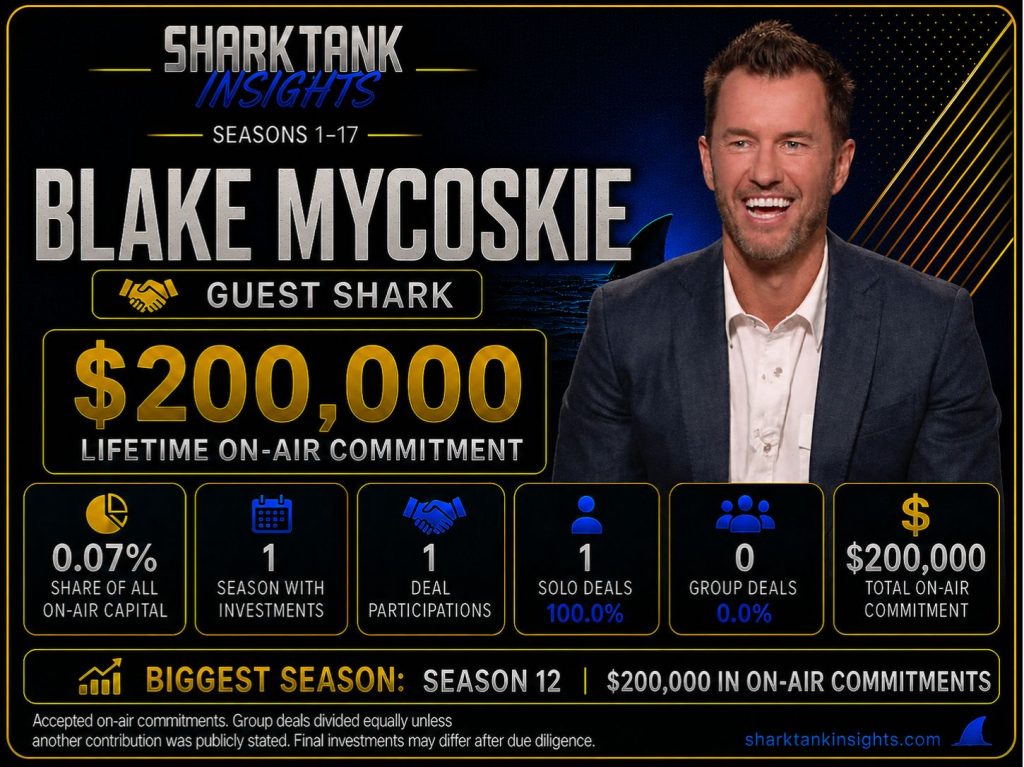
Blake Mycoskie invested $200,000 on Shark Tank through one accepted deal. He gave the complete amount to Touch Up Cup in Season 12. Blake never participated in another accepted Shark Tank investment afterward.
The investment history is quite straightforward because Blake did not get involved in complicated royalties, loans or group agreements. There was no line of credit or acquisition involved either. He simply offered $200,000 against 25% of Touch Up Cup, and the founders accepted it.
However, Shark Tank represents a very small part of Blake’s complete investing career. He had already invested money in different socially focused businesses before sitting on the Shark chair. The success of TOMS gave him enough experience and capital to support younger entrepreneurs through his Social Entrepreneurship Fund.
Shark Tank provided Blake with another platform to use the same experience. Instead of backing established companies, he could sit in front of entrepreneurs looking for money, connections and guidance. Touch Up Cup eventually became the only company he chose to invest in.
Touch Up Cup
Jason and Carson Grill entered Shark Tank with Touch Up Cup, a simple solution to an annoying household problem. Everyone who has painted a house knows that leftover paint normally ends up sitting inside a metal can. The cans can rust, the paint can clump, and opening the container months later sometimes leaves you with something that is hardly usable.
The father-son duo wanted to solve this problem. Touch Up Cup was a small storage container designed to preserve leftover paint for future touch-ups. Instead of keeping a huge rusty paint can in the garage, consumers could store the remaining paint inside a more practical container.
The company also had an interesting young entrepreneur behind it. Carson Grill was just 15 years old when he entered the Tank with his father, Jason. However, his age did not stop him from understanding the business and answering the Sharks’ questions.
Touch Up Cup used an airtight container and a stainless-steel mixing sphere to keep the stored paint usable. When a wall gets scratched months later, the consumer can shake the container and use the remaining paint instead of buying a completely new can. The idea was simple, but it solved the rust and storage problems connected with ordinary paint cans.
Jason and Carson demanded $150,000 for 10% of their company. This gave Touch Up Cup an initial valuation of $1.5 million. The business had sales, intellectual property and retail distribution, so it was not one of those ideas entering Shark Tank with nothing more than a prototype.
The numbers caught the attention of more than one Shark. However, Blake appeared interested not only in Touch Up Cup but also in the young entrepreneur standing in front of him.
Blake Mycoskie’s Touch Up Cup Deal
Blake Mycoskie seemed impressed with Carson from the beginning. A 15-year-old knowing everything about his product, sales and business numbers was not something the Sharks saw in every pitch. Blake saw an entrepreneur who could probably grow with the company.
He offered Jason and Carson $200,000 for a 25% stake in Touch Up Cup. Interestingly, Blake put $50,000 more on the table than the founders had originally asked for. However, the additional money came with a much higher equity demand.
Daymond John also showed interest in the company and came forward with a competing offer. Suddenly, Jason and Carson had more than one Shark willing to join their paint-storage business.
| Shark(s) name | Offer | Demand | Counteroffer | Accepted? |
|---|---|---|---|---|
| Blake Mycoskie | $200,000 | 25% equity | N/A | Yes |
| Daymond John | Competing offer | N/A | N/A | No |
In the end, the father-son duo decided to work with Blake. They accepted his $200,000 offer for 25% equity in Touch Up Cup. The final agreement valued the company at approximately $800,000, which was much lower than the $1.5 million valuation Jason and Carson carried into the Tank.
Still, the founders were not choosing an investor based only on valuation. Blake had years of experience building physical consumer products, dealing with retailers and developing a brand around a relatively simple idea. Touch Up Cup needed exactly these skills if it wanted to become more than a container for old paint.
Blake also made it clear that he wanted to help grow the company instead of just putting money into it. His hands-on interest made the offer more attractive. Jason and Carson eventually picked Blake over Daymond, and Blake Mycoskie had his first Shark Tank deal.
Interestingly, it also became his last accepted investment on the show.
Why Blake Mycoskie Invested in Touch Up Cup
Carson Grill was probably one of the biggest reasons Blake developed confidence in Touch Up Cup. Despite being only 15 years old, Carson had a solid grip on the manufacturing cost, wholesale pricing, selling price, patents and sales of the company. The young entrepreneur did not look lost when Sharks started throwing business questions at him.
This matters a lot inside Shark Tank. A good product can attract attention, but Sharks normally lose confidence when entrepreneurs do not understand their own numbers. Carson did the opposite and showed that his age had nothing to do with his understanding of the company.
Touch Up Cup also had something many young businesses lacked: proof of demand. The company had already generated around $220,000 in sales before appearing on Shark Tank. Moreover, the products had entered thousands of retail locations.
Therefore, Blake was not being asked to gamble $200,000 on an untested idea. Customers had purchased the product, retailers were keeping it, and the founders had intellectual property around the concept. Touch Up Cup had already done the basics right.
The product itself also fit Blake’s background. It did not require complicated software or a business model that would take hours to understand. Touch Up Cup solved one household problem through a fairly inexpensive physical product.
The company could expand through hardware stores, home improvement retailers, online marketplaces and other consumer channels. Blake had already spent years understanding product branding and retail distribution through TOMS. Considering this, Touch Up Cup was a business he could actually help.
Touch Up Cup After Shark Tank
Touch Up Cup got the publicity every entrepreneur expects after appearing on Shark Tank. Carson’s story as a teenage entrepreneur also gave people another reason to remember the company. However, the post-show journey did not end with a temporary increase in website visitors.
The business continued growing and moved beyond the paint-storage cup presented in the Tank. Touch Up Cup added paint brushes, roller cleaning tools, brush keepers, roller keepers, painting tarps and different bundles to its collection. The expansion converted a one-product company into something closer to a complete painting accessories brand.
From our Touch Up Cup research, this expansion makes sense. A company selling only one paint-storage container could eventually face limited growth opportunities. However, customers buying a Touch Up Cup are the same people who could also require brushes, rollers, tarps and other painting accessories.
This gave the company an opportunity to sell multiple products to the same consumer. Blake’s background in developing consumer brands also made him a suitable investor for this type of expansion. Instead of changing the business completely, Touch Up Cup simply built around the problem it was already solving.
The company also reached major retailers after Shark Tank. Touch Up Cup products became available through Walmart along with different online platforms. Moreover, the business continued selling directly through its official website.
As of 2026, consumers can still purchase Touch Up Cup products. This is important because many Shark Tank companies enjoy the television boost and disappear a few years later. Touch Up Cup managed to survive beyond the hype.
Is Touch Up Cup Still in Business?
Yes, Touch Up Cup is still in business in 2026. The official website remains operational and sells the original paint-storage product along with several other painting accessories. The business has survived for more than five years after appearing on Shark Tank.
I consider Touch Up Cup one of those Season 12 businesses people can easily overlook. It did not become a billion-dollar company or dominate the headlines after the show. However, the product survived, the company expanded, and consumers are still able to purchase it.
The current collection is also much bigger than what Carson originally presented to the Sharks. Customers can purchase paint storage cups, brushes, painting tarps, roller-saving products and complete bundles. The company has also targeted painters, landlords, contractors and property professionals through bulk products.
This makes Blake’s only Shark Tank investment more interesting. Several accepted television deals disappear during due diligence or the businesses shut down after a few years. Blake only selected one company, but that company continued operating.
So basically, there is no large portfolio to hide a bad investment inside. Touch Up Cup has to represent Blake’s entire Shark Tank record on its own. Fortunately for him, the business is still alive.
Did Blake Mycoskie’s Touch Up Cup Deal Close?
There is strong public evidence suggesting that Blake Mycoskie continued his relationship with Touch Up Cup after the episode. Later updates from the business connected Blake with the company’s growth, marketing and product development. Jason and Carson have also continued mentioning him as the Shark attached to Touch Up Cup.
However, private Shark Tank agreements are rarely available for the public to inspect. The deal viewers see on television is an accepted agreement, while the final paperwork normally happens after the entrepreneurs leave the Tank. Therefore, every accepted offer should not automatically be treated as a completed investment.
In the case of Touch Up Cup, the evidence looks much better than businesses where founders later confirmed that negotiations collapsed. Blake remained connected with the company publicly, while the business continued growing after the show. Considering this, the safest conclusion is that the Touch Up Cup investment has strong public support as a completed or continuing deal.
The exact financial return is another story. Touch Up Cup is privately owned, and Blake has never publicly disclosed how much money he made from the investment. Therefore, putting an exact profit number on his $200,000 would be nothing more than guesswork.
What Was Blake Mycoskie’s Largest Shark Tank Investment?
Blake Mycoskie’s largest Shark Tank investment was $200,000 in Touch Up Cup. He received 25% equity in the company under the deal agreed on television. Interestingly, it was also his smallest investment because Blake did not close another Shark Tank deal.
This makes his investment record quite unusual. Sharks such as Mark Cuban, Lori Greiner and Kevin O’Leary have portfolios consisting of dozens of companies. Blake’s complete record can be explained with one company and one $200,000 cheque.
Touch Up Cup entered the Tank with a $1.5 million valuation after asking for $150,000 against 10% equity. Blake did not agree with the same numbers. He increased the investment to $200,000 but demanded one-fourth of the company.
The accepted terms reduced the company’s valuation to around $800,000. Jason and Carson surrendered much more equity than they originally planned, but they also received an additional $50,000 and Blake’s experience. The founders considered the complete package worth the sacrifice.
The deal also showed another side of Blake Mycoskie. His public image is friendly and heavily connected with social entrepreneurship, but that did not stop him from negotiating. Blake liked both the founder and the business, yet he still demanded a valuation that made sense for him.
He did not simply throw money at an entrepreneur because Carson’s story was inspiring. Blake increased the cheque and took a bigger chunk of the business in return. In the end, both sides got what they wanted, and Touch Up Cup became the only company in Blake Mycoskie’s Shark Tank portfolio.
Blake Mycoskie’s Investment Style
Blake Mycoskie brought a different mindset to the Shark Tank panel. His entrepreneurial journey was never limited to making money because TOMS built its complete identity around profit and social impact. Therefore, Blake normally looked at the entrepreneur, mission and future possibilities along with the financial numbers.
His experience with TOMS made him familiar with physical consumer products as well. Blake had spent years dealing with manufacturing, branding, retail distribution and international expansion. More importantly, he understood how a simple product could become a recognizable brand if consumers connected with the story behind it.
This was one reason Touch Up Cup made sense for him. The company did not have a complicated technology or revolutionary business model. It had a simple household product that needed stronger branding, wider retail distribution and additional products to expand.
Blake also seemed attracted to entrepreneurs with grit. His own career was not a straight road to success because he experimented with several businesses before finally creating TOMS. Some ventures worked while others failed. Therefore, a young entrepreneur willing to learn and build could easily catch his attention.
Carson Grill checked this box. He was still attending school but already understood the economics of his company. The product was simple, but Carson’s confidence made Blake believe there was something more behind Touch Up Cup.
Why Blake Mycoskie Invested Differently
Blake Mycoskie did not make his fortune by sitting inside a private equity office and analyzing spreadsheets all day. He started businesses himself and learned entrepreneurship after going through successes and failures. This gave him a founder’s perspective whenever he assessed another entrepreneur.
Before TOMS became successful, Blake tried his hands on different ventures. He knew that a good idea does not automatically turn into a successful company. The founder still has to sell, adapt, build a brand and survive the difficult stages before the business becomes valuable.
His investment activities outside Shark Tank also followed a similar approach. After selling half of TOMS in 2014, Blake used a considerable part of the money to support companies trying to create social impact. The businesses still had to make financial sense, but earning money was not the only thing on his checklist.
Touch Up Cup was not exactly a social enterprise. No major social mission was attached to storing leftover paint. However, Carson had several qualities Blake normally liked in entrepreneurs.
The teenager noticed a small problem inside his home and turned it into a sellable product. He protected the concept through intellectual property, understood the financial numbers and reached retail stores before appearing on national television. The business already had some wheels underneath it.
Blake appeared to be investing in Carson as much as he was investing in Touch Up Cup. A product can be copied or replaced, but a capable entrepreneur can continue developing new products. Considering the expansion Touch Up Cup achieved afterward, this part of the investment made sense.
Blake Mycoskie Net Worth
Blake Mycoskie’s exact net worth is not publicly confirmed. Unlike the value of a public company, private businesses and investments make it difficult to determine the exact wealth of an entrepreneur. However, one of the stronger public estimates placed his fortune at around $400 million in 2023.
The figure should still be treated as an estimate. Blake has invested in different private companies, funds and projects where the current valuations are not completely available to the public. Therefore, any exact net worth figure can change depending on how these private assets are valued.
TOMS created the majority of Blake’s original fortune. The company became a globally recognized shoe brand and reached a valuation of more than $600 million when Bain Capital purchased 50% of the business in 2014. Blake received a major personal payout through the transaction.
However, his relationship with TOMS did not remain the same forever. The company later faced financial difficulties and accumulated considerable debt. Creditors eventually took control in 2019, which wiped out Blake’s remaining ownership.
This sounds disastrous until you remember that Blake had already monetized a large part of his stake years earlier. The 2014 deal gave him enough capital to diversify into investments, philanthropy and other ventures. Therefore, losing his remaining TOMS ownership did not mean losing the complete fortune he had built.
Blake Mycoskie’s Early Life
Blake Mycoskie was born on August 26, 1976, in Arlington, Texas. Before entrepreneurship became his career, tennis occupied a large portion of his life. He played competitively and attended Southern Methodist University on a partial tennis scholarship.
However, an Achilles injury changed his plans. Competitive tennis was no longer a realistic career path, forcing Blake to look elsewhere. The setback eventually pushed him toward business.
Blake left college and started a laundry service targeting university students. The idea was not glamorous, but students always needed clean clothes and many were willing to pay for convenience. The business expanded to several campuses before Blake eventually sold his stake.
This became the starting point of a pattern that followed him throughout his career. Blake would notice an ordinary problem, find a way to turn the solution into a business and move forward from there. Some ideas became successful while others eventually disappeared.
TOMS was still several businesses away. However, these early experiments taught Blake something that a business school textbook probably could not. Entrepreneurship involved testing an idea in the real market and accepting that failure was always part of the game.
Blake Mycoskie’s Career Before TOMS
Blake Mycoskie did not become the founder of TOMS immediately after his first business. He spent years experimenting with different industries and trying to find another opportunity that could work. His career before TOMS had both wins and failures.
After his laundry business, Blake started an outdoor advertising company called Mycoskie Media. The business focused heavily on the entertainment industry and eventually attracted enough attention to get acquired.
He later entered the television industry with Reality Central. The idea was to create a network focused on reality television at a time when the genre was becoming increasingly popular. The company managed to raise outside capital, but competition eventually made the business difficult to sustain.
Reality Central failed. However, Blake did not disappear from entrepreneurship after losing the venture. He continued experimenting with marketing and driver education businesses before eventually coming across the idea that would transform his career.
These failures are important when understanding Blake as an investor. He knows from personal experience that an impressive presentation cannot guarantee future success. A company can have capital, a promising market and talented people and still fail.
By the time Blake walked into Shark Tank, he had already lived through both sides of entrepreneurship. This gave him a different perspective when evaluating founders who were still trying to figure everything out.
How Did Blake Mycoskie Make Money?
Blake Mycoskie made the largest portion of his fortune through TOMS Shoes. He founded the business in 2006 after visiting Argentina and noticing children who did not have adequate footwear. The experience gave him an idea to connect shoe sales directly with charitable giving.
The business model was straightforward. Whenever a customer purchased a pair of TOMS shoes, the company would provide another pair to someone in need. This concept became famous as the One for One model.
Customers were suddenly buying more than footwear. A purchase also made them feel connected to a social cause. It was a brilliant way to combine a consumer product with a story that people could understand immediately.
The idea took off. TOMS expanded from a relatively simple shoe business into an international consumer brand. The company later entered eyewear, coffee, bags and other product categories while continuing to connect its operations with different social causes.
The success turned Blake into a multimillionaire. More importantly, it made him one of the most recognizable faces of social entrepreneurship. Business schools, entrepreneurs and consumers began discussing the One for One model as a new way to mix commercial success with giving.
However, TOMS was still a for-profit business. The social mission attracted consumers, but the company had to sell enough products to survive. Blake successfully proved for years that a strong cause and an effective consumer brand could work together.
TOMS
TOMS started with a simple shoe inspired by the traditional Argentine alpargata. There was nothing technologically extraordinary about the footwear. The powerful part of the business was the story attached to every pair.
Blake believed customers would appreciate knowing that their purchase could help another person. Therefore, giving was not kept on a separate charity page of the company. It became part of the product itself.
The One for One model helped TOMS stand out in the crowded footwear market. A consumer could purchase shoes from hundreds of different brands, but very few competitors had such a simple mission attached to the transaction. The story became one of the company’s biggest marketing strengths.
TOMS grew rapidly and eventually donated millions of pairs of shoes through its programs. The company later expanded beyond footwear into eyewear and other product categories. Different products supported different causes, allowing the company to stretch the original philosophy into new markets.
The biggest financial moment arrived in 2014. Bain Capital purchased 50% of TOMS in a transaction that valued the company at approximately $625 million. Blake kept the remaining ownership while receiving a major payout from the sale.
The deal gave him two things. Blake had financial security from converting part of his company into cash, while he also remained attached to TOMS through his remaining ownership. Moreover, the transaction gave him capital that could be invested in other entrepreneurs.
Instead of keeping all the money for himself, Blake used part of the payout to support social entrepreneurship. The move perfectly matched the philosophy he had used to build TOMS in the first place.
What Happened to Blake Mycoskie’s Ownership of TOMS?
Blake Mycoskie continued owning a considerable stake in TOMS after the 2014 transaction with Bain Capital. However, the company later entered a difficult period. Competition became stronger while debt created additional pressure on the business.
TOMS eventually needed financial restructuring. In 2019, creditors took control of the company as part of an agreement designed to deal with its debt problems. Blake’s remaining ownership disappeared during the process.
So basically, the founder no longer owned the company that had made him famous. TOMS continued operating, but Blake was no longer financially controlling the business. It was a disappointing ending to his ownership journey.
However, the situation should not be confused with Blake walking away empty-handed. He had already sold half of TOMS several years earlier at a valuation exceeding $600 million. The money earned during that transaction had already allowed him to invest and diversify outside the company.
Losing the remaining TOMS stake closed one chapter of his entrepreneurial career. Blake later focused more heavily on investing, wellness, philanthropy and different personal projects. The shoe business built his fortune, but it did not remain the only thing defining him.
Social Entrepreneurship Fund
Blake Mycoskie used part of the money earned from TOMS to invest in other entrepreneurs. He established the Social Entrepreneurship Fund with the purpose of supporting early-stage businesses that combined commercial opportunity with a meaningful social mission.
The idea was basically an extension of what Blake had already done with TOMS. Instead of building every socially focused company himself, he could provide capital to other entrepreneurs trying to solve problems through business.
By the time Blake appeared on Shark Tank, he had reportedly invested in more than 25 social enterprises. The businesses covered different areas, including healthcare, education, environmental problems and other social issues.
Therefore, Blake was not merely a celebrity founder invited to occupy a Shark chair. He already had experience assessing early-stage companies and putting his own money behind entrepreneurs. Shark Tank simply brought this investing activity in front of television cameras.
The fund also explains why Blake does not look exclusively at projected profits. Financial returns obviously matter because an investment has to survive. However, he has regularly shown interest in businesses that can make money while accomplishing something useful at the same time.
This approach differentiates Blake from investors who first study the financial opportunity and only later think about social impact. For him, both factors can exist inside the same business model.
Madefor
Blake Mycoskie later entered the wellness industry through Madefor. He co-founded the company with former Navy SEAL Pat Dossett. The business focused on helping people develop better habits rather than selling an instant transformation.
Madefor created a wellness program around areas such as sleep, hydration, movement, gratitude and breathing. Instead of asking customers to change everything at once, the system focused on improving one habit at a time.
The company also worked with professionals from neuroscience, psychology, physiology and behavioral science. This gave Madefor a more structured approach than a simple motivational program. Blake wanted users to develop habits that could survive after the initial excitement disappeared.
Madefor represented another change in Blake’s entrepreneurial journey. TOMS was built around physical consumer products and charitable giving. Madefor moved him deeper into personal wellness and behavioral science.
However, one similarity remained. Blake was again working on a business where the product was connected with something larger than the transaction itself. The customer was not simply purchasing an item; the company was trying to change something in their life.
ENOUGH
Blake Mycoskie launched another project called ENOUGH in 2026. The initiative focuses on mental wellness and the idea that continuously chasing achievement does not necessarily make a person satisfied.
The concept came partly from Blake’s own experiences. He spent years building TOMS into an international company and connected a large portion of his identity with the success of the business. However, leaving the company created another problem.
Success had given him money and recognition, but it did not answer every personal question. Blake has discussed the difficulties he faced in finding purpose once the business that dominated his life was no longer his responsibility.
ENOUGH turns those experiences into a broader discussion around mental health and emotional well-being. Products connected with the project are designed to act as reminders while also supporting mental-health organizations.
The project continues a familiar pattern in Blake’s career. TOMS connected shoes with giving. Madefor connected a wellness product with habit development. ENOUGH connects consumer products with the message of mental well-being.
Blake appears most interested when a business has something to say beyond the item being sold. This philosophy has stayed with him even as the industries around his projects changed.
Blake Mycoskie and Philanthropy
Philanthropy has remained closely connected with Blake Mycoskie’s entrepreneurial career. TOMS became famous because giving was included directly inside the company’s original business model. However, Blake’s philanthropic interests eventually moved into areas beyond footwear.
Mental health became one of the major areas of focus. Blake has supported research involving psychedelic-assisted treatments and consciousness. He provided funding to Johns Hopkins for research connected with psychedelics.
He later committed more capital toward companies and research working in the same developing field. The subject remains complicated, but Blake has shown interest in finding new approaches to mental-health treatment.
His philanthropy and investing sometimes become difficult to separate. Blake likes projects where capital can create a financial return and positive impact at the same time. This is basically the philosophy that followed him from TOMS into his later investments.
Not every company Blake invests in needs to save the world. Touch Up Cup certainly did not. However, his wider career makes it clear that he feels more connected with founders and projects that stand for something beyond the financial numbers.
Why Blake Mycoskie Was a Strong Guest Shark
Blake Mycoskie brought experience to Shark Tank that was quite different from the regular investors. He had personally taken a simple consumer product and built a global brand around storytelling, retail distribution and social impact.
This experience could be extremely useful for entrepreneurs selling physical products. Getting a product manufactured is one challenge, but building a recognizable consumer brand is another game. Blake had already experienced both.
He also understood the importance of storytelling. TOMS was not successful because the shoes were impossible to copy. Consumers remembered the story behind the company.
This gave Blake an advantage with products that needed an identity rather than more technology. A simple product can easily disappear on a retail shelf if customers have no reason to remember it. Blake knew how branding could solve this problem.
Touch Up Cup needed exactly these skills. The container was easy to understand and solved a real problem, but the future of the company depended on expanding retail distribution and creating additional products around the original idea.
The company eventually did exactly that. Touch Up Cup moved into brushes, roller tools, tarps and other painting accessories. The expansion made Blake’s background look like an appropriate match for the business.
His value as a Shark was therefore not measured only through the amount of money he invested. Blake could help an entrepreneur understand how a small consumer product turns into a brand. That experience is difficult to place on a valuation sheet.
Blake Mycoskie’s Shark Tank Performance
Blake Mycoskie made just one accepted investment during his time on Shark Tank. He committed $200,000 to Touch Up Cup for 25% equity in Season 12. That single transaction represents his complete lifetime investment on the show.
At first glance, the record looks extremely small. Other Sharks invested in dozens or even hundreds of accepted deals over multiple seasons. Blake did not have enough appearances to build anything close to that type of portfolio.
However, quantity tells only one side of the story. Touch Up Cup survived after Shark Tank and expanded beyond the product originally presented in the Tank. The business is still active years after the episode.
This gives Blake a fairly unusual Shark Tank record. He does not have ten companies where a few winners can compensate for several failures. His complete television investment portfolio depends on Touch Up Cup.
Fortunately, the company continued operating. It expanded its product line and entered bigger retail channels rather than disappearing after receiving the Shark Tank publicity. Blake’s only accepted investment remained a real business.
The $200,000 figure still looks tiny compared with the multimillion-dollar commitments made by long-serving Sharks. However, Shark Tank was never Blake’s main investing platform.
Before joining the show, he had already put money behind numerous companies through his investment activities. Therefore, judging his complete investing career through one Shark Tank deal would create the wrong picture.
His Shark Tank performance is better viewed as a very short sample of his wider investment philosophy. Blake found one young founder and one consumer product that matched his experience. He made the offer, got the deal and continued with a company that survived.
Conclusion
Blake Mycoskie committed $200,000 during his time on Shark Tank. The complete investment went to Touch Up Cup in Season 12, making it his first and only accepted deal on the show. Blake offered Jason and Carson Grill $200,000 for a 25% share in their paint-storage business.
The deal looked promising because Touch Up Cup already had sales, retail distribution and a young entrepreneur who knew his numbers. Blake also had the right background to help because he understood physical products, branding and retail expansion through his experience with TOMS.
Touch Up Cup continued growing after its Shark Tank appearance. The company expanded beyond the original paint-storage container into brushes, roller products, tarps and other painting accessories. As of 2026, the business is still operating and selling products through its website and major retail channels.
Blake’s Shark Tank portfolio is small, but his entrepreneurial career is anything but small. He founded TOMS, turned the One for One idea into one of the most recognizable social entrepreneurship models and later sold half of the company in a transaction valuing TOMS at more than $600 million.
He continued investing in social enterprises, co-founded Madefor and moved deeper into mental wellness through later projects such as ENOUGH. His career has repeatedly mixed business with a larger purpose, even though not every investment follows exactly the same model.
Touch Up Cup explains quite well what Blake saw when he entered Shark Tank. The product was simple, but there was a capable entrepreneur behind it and enough room to build something larger around the original concept.
Blake spent much of his career proving that ordinary physical products can become valuable brands when the founder gets the storytelling, distribution and customer connection right. He applied the same thinking to Touch Up Cup. Interestingly, the only company he backed inside the Tank gave him a chance to use almost every skill that had helped him build TOMS in the first place.

Hi. I’m Daniyal Durrani. A CA-finalist, CPA-UK, and Master in Economics, with a decade-long business studies experience. I work as an Audit and Business Advisory Manager in a globally recognized accounting firm. I have been watching Shark Tank for a long time and have always admired the innovative business ideas. The revolutionary solutions to unaddressed day-to-day problems presented on the show used to impress me like no other thing on TV. Read more About me.