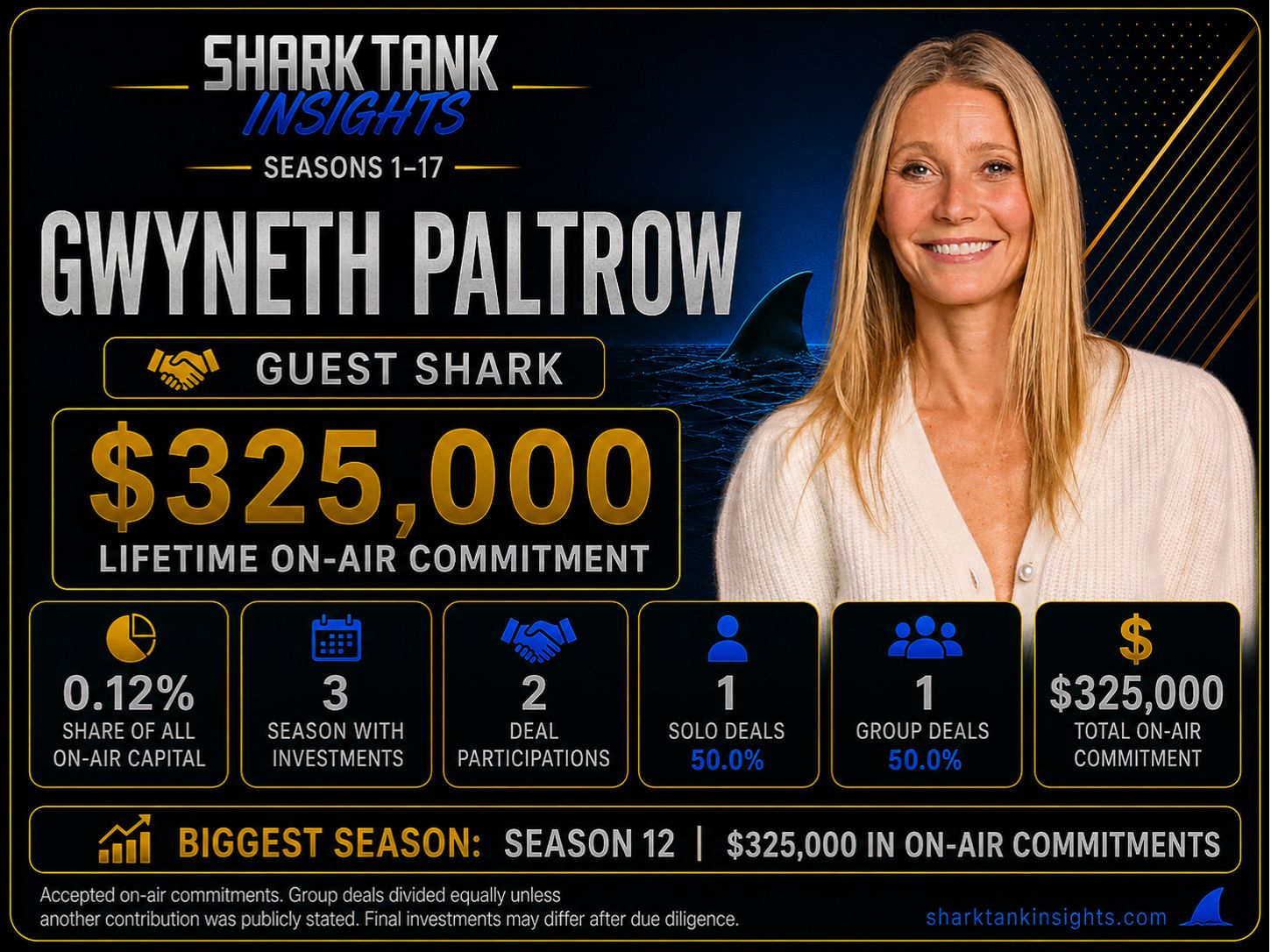
Gwyneth Paltrow entered Shark Tank Season 14 with years of business experience outside Hollywood. She was already popular for acting, but Goop had turned Gwyneth into an entrepreneur dealing with wellness, beauty, fashion and consumer products. Therefore, Gwyneth did not come on the show only with a famous name because she had already spent years building a consumer business.
However, she did not remain on Shark Tank long enough to build a big portfolio. Gwyneth made two accepted deals from her two Season 14 appearances, investing in Kudos and Milkify. Her attributed investment from the two companies came to $325,000.
The largest one was Milkify, where Gwyneth partnered with Lori Greiner. The complete agreement involved $400,000 in convertible financing, giving Gwyneth an attributed $200,000 investment when divided equally. She invested the remaining $125,000 with Mark Cuban in Kudos.
Interestingly, Milkify carried much more of Gwyneth’s Shark Tank money. The $200,000 represented around 61.5% of the complete amount, while Kudos contributed the remaining 38.5%. Without Milkify, Gwyneth’s complete investment record would have stopped at only $125,000.
The $325,000 figure has another problem that should not be ignored. Milkify has stronger public evidence behind the completed agreement, while the final situation around Kudos remains conflicting. Therefore, Gwyneth’s accepted Shark Tank investment and publicly supported actual investment should not be considered the same number.
Gwyneth Paltrow Shark Tank Investment Summary
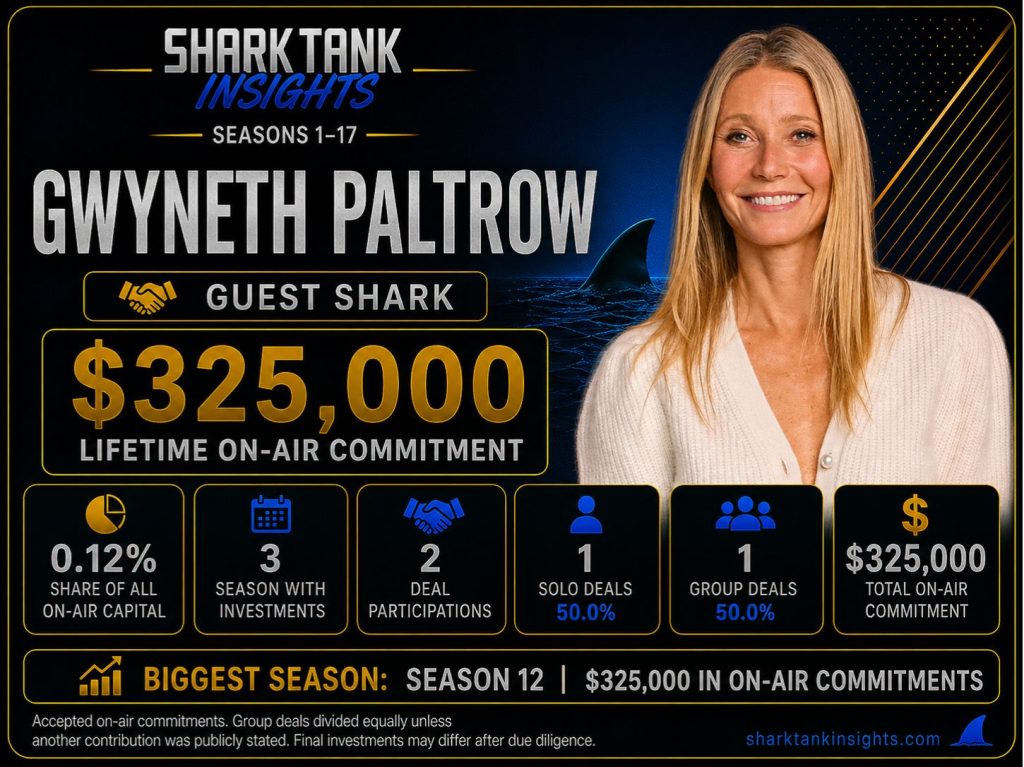
| Statistic | Gwyneth Paltrow’s Record |
|---|---|
| Accepted on-air commitments | $325,000 |
| Seasons with investments | 1 |
| Accepted deals | 2 |
| Solo deals | 0 |
| Group deals | 2 |
| Largest attributed commitment | $200,000 — Milkify |
| Second-largest commitment | $125,000 — Kudos |
| Publicly supported completed investment | At least $200,000 |
| Average commitment | $162,500 |
Gwyneth Paltrow committed $325,000 across two accepted Shark Tank investments. Both companies involved another Shark, meaning Gwyneth never invested alone during her short run on the show. Two companies are enough to explain her complete Shark Tank portfolio.
The calculation does not have much complication either. Mark and Gwyneth shared the $250,000 Kudos agreement, while Lori and Gwyneth divided the $400,000 Milkify financing. No different contribution has been publicly disclosed, so Gwyneth gets $125,000 from Kudos and another $200,000 from Milkify.
This gives Gwyneth an average commitment of $162,500 per accepted deal. Since there are only two investments, the number does not tell us much about how she would normally invest after watching dozens of companies. Gwyneth never stayed long enough to find out.
The $325,000 also looks small beside the money attached to Gwyneth outside Shark Tank. She had already spent years building Goop while acting had made her wealthy long before Season 14. Therefore, a $162,500 average Shark Tank investment was not a massive cheque by her standards.
However, having money does not mean a Shark should accept every valuation. Entrepreneurs regularly enter the Tank believing their company is worth much more than the Sharks think. Gwyneth still needed an investment structure that made sense for her.
This became obvious with Milkify. The founders wanted $400,000 for 10%, but Gwyneth and Lori did not simply accept the original equity offer. Gwyneth liked the company, but liking a business and liking its valuation are different things.
How Much Did Gwyneth Paltrow Invest on Shark Tank?
Gwyneth Paltrow invested an attributed $325,000 in two Shark Tank companies. Her first accepted deal was Kudos with Mark Cuban, while Milkify later became her larger investment with Lori Greiner. Both agreements were made during Season 14.
| Company | Accepted Deal | Gwyneth Paltrow’s Attributed Commitment |
|---|---|---|
| Kudos | $250,000 for 7% equity + 3% advisory shares | $125,000 |
| Milkify | $400,000 convertible financing | $200,000 |
| Total | $325,000 |
Amrita Saigal entered Shark Tank with Kudos, a disposable diaper company built around cotton and more sustainable materials. Gwyneth showed interest and eventually partnered with Mark on the $250,000 agreement. Under an equal split, Gwyneth’s contribution came to $125,000.
Milkify was the second investment. Dr. Berkley Luck and Pedro Silva accepted $400,000 in convertible financing from Gwyneth and Lori after presenting their breast-milk freeze-drying business. This gives Gwyneth the remaining $200,000 in her investment record.
Only $75,000 separated both investments. Milkify contributed $200,000, while Kudos added another $125,000. Gwyneth placed decent money into both companies, but Milkify was clearly the bigger bet.
This is where her small portfolio gets interesting. Kudos operated around babies, sustainability and disposable products, while Milkify combined motherhood, wellness and a complicated service business. Both companies looked different, but neither one was far away from the customers Gwyneth already understood.
Gwyneth Paltrow Invested $125,000 in Kudos
Amrita Saigal created Kudos after looking at the materials used inside ordinary disposable diapers. She wanted cotton touching more of the baby’s skin instead of the plastic commonly used by other disposable products. Parents already needed diapers, so Amrita was improving an existing purchase rather than convincing people to create a new habit.
The idea seemed feasible, but the diaper industry is not easy for a young company. Pampers, Huggies and other established brands already have huge distribution, strong retailers and years of trust with parents. Kudos needed more than cotton to make enough customers switch.
Amrita entered Shark Tank asking for $250,000 for 5% equity. Gwyneth and Mark eventually agreed to $250,000 for 7% equity plus another 3% in advisory shares. Under the equal-split method, Gwyneth receives a $125,000 attributed commitment.
The product also had something interesting that many consumer businesses struggle to create. Repeat purchases. Parents who like Kudos can continue buying diapers for months instead of making one purchase and disappearing.
This makes the business model much more interesting. Once Kudos convinces a family to switch, it has an opportunity to keep selling the same household another packet and then another one. Customer retention therefore matters almost as much as finding new parents.
However, the pricing can spoil the fun. Babies use several diapers every day, so even a small premium becomes much more noticeable after another week or month. Parents might like the sustainability story and still choose the cheaper product when they reach the shelf.
Competition creates the same problem. A large diaper company can spend more money on advertising, fight for better shelf space and use its scale to pressure pricing. Kudos therefore needs customers to see enough difference in the product instead of treating it as another expensive diaper.
This is where Gwyneth could actually help. Goop had spent years convincing customers to pay premium prices for products connected with wellness and lifestyle. Kudos did not only get access to Gwyneth’s $125,000; it got an investor who understood why branding and customer trust can decide whether a premium consumer product survives.
The company continued growing after Shark Tank. Kudos raised additional funding, improved its manufacturing and expanded into Target while continuing to sell diapers and wipes. The company became much bigger than a business simply enjoying a temporary Shark Tank traffic boost.
However, this does not automatically make Gwyneth’s investment successful. Public information regarding the final agreement with Gwyneth and Mark remains conflicting, despite the company raising money and entering more stores. A successful company and a successful Shark investment can still move in different directions.
Therefore, I would keep the $125,000 inside Gwyneth’s accepted Shark Tank commitment. There is not enough public support to confidently treat the amount as completed funding under the final agreement. Assuming the deal either closed or failed would go further than the evidence.
Gwyneth Paltrow Invested $200,000 in Milkify
Milkify became Gwyneth Paltrow’s largest attributed Shark Tank investment at $200,000. Dr. Berkley Luck and Pedro Silva created a service that freeze-dried breast milk into powder so mothers could preserve it for much longer. At first glance, the problem was easy to understand.
However, Milkify was not another simple baby product. The company had to receive breast milk, process it correctly and return something mothers would later feed to their babies. This made trust one of the most important parts of the business.
The service could definitely solve a real problem. Mothers who had built up frozen milk normally had limited storage time and had to worry about moving or transporting it. Milkify basically gave the milk a much longer life without forcing mothers to throw away something they had worked hard to produce.
The business had another problem. Equipment, processing, shipping and storage made Milkify much more complicated than a normal direct-to-consumer product. Growth could become expensive if the company had to continuously add more capacity.
This is similar to businesses where the opportunity looks attractive until operations start eating the excitement. Milkify can acquire thousands of customers, but every new order still has to move through the freeze-drying process correctly. The company cannot simply manufacture another million cheap units and place them inside a warehouse.
Berkley and Pedro entered Shark Tank asking for $400,000 for 10% equity. The demand placed a $4 million valuation on Milkify. Gwyneth understood the product but did not agree with paying that price under a normal equity deal.
This is where the negotiation changed. Gwyneth and Lori moved toward $400,000 in convertible financing connected with an option for 20% ownership instead of accepting the original equity demand. The founders kept the deal alive by becoming flexible with the structure.
Under an equal split, Gwyneth receives $200,000 of the complete commitment. Milkify therefore represents around 61.5% of everything Gwyneth invested on Shark Tank. Without this one company, most of her Shark Tank money disappears.
The partnership also had some logic behind it. Gwyneth understood wellness, motherhood and premium consumers, while Lori had years of experience with consumer products and growing companies after television exposure. Milkify got two Sharks with different strengths instead of two investors bringing exactly the same knowledge.
Still, the business could not survive only because two famous investors liked it. Mothers needed to trust the process, and Milkify had to handle every package without creating a serious operational problem. One mistake involving breast milk could hit the company much harder than an ordinary late delivery.
Milkify continued operating after Shark Tank. The company expanded its facilities and equipment, while the founders reported that monthly sales more than tripled following the appearance. The growth was encouraging, but larger sales also meant Milkify had to process much more milk without dropping the quality.
The bright aspect is that Gwyneth’s $200,000 has stronger public support as completed funding. Milkify therefore carries both the largest accepted commitment and the complete minimum supported investment in Gwyneth’s portfolio. For only two Shark Tank deals, one company ended up doing most of the work.
Gwyneth Paltrow’s On-Air Investment Vs Actual Investment
Gwyneth Paltrow’s $325,000 Shark Tank investment figure tells only one side of the story. The amount represents her share of the two accepted agreements with Mark Cuban and Lori Greiner. It does not mean that the complete $325,000 definitely left Gwyneth’s bank account after filming.
Kudos contributes $125,000 to the television total, but the final agreement remains uncertain. Therefore, I would not include this money when calculating Gwyneth’s minimum publicly supported actual investment. She agreed to invest the money, but the post-show situation spoils the calculation.
Milkify contributes the remaining $200,000 and has much stronger evidence behind it. The company continued discussing Gwyneth and Lori after Shark Tank while expanding the business. Considering this, the $200,000 can reasonably sit inside Gwyneth’s publicly supported completed funding.
So basically, Gwyneth has $325,000 in accepted Shark Tank commitments and at least $200,000 in publicly supported actual investment. Around 61.5% of her television portfolio has strong enough evidence behind it. The remaining $125,000 stays connected with Kudos until better information appears.
However, even the $200,000 does not tell us how much Gwyneth earned. Milkify is privately owned, and the final ownership and return information are not public. A completed investment can still make money, lose money or sit somewhere in the middle.
Gwyneth Paltrow’s Shark Tank Investment Style
Two Shark Tank deals are not enough to judge Gwyneth Paltrow’s complete investment strategy. However, both companies showed one thing clearly: Gwyneth stayed around consumers she already understood. Motherhood, wellness, sustainability and premium consumer products appeared quickly.
Kudos was probably the more obvious brand investment. Gwyneth had spent years building Goop around consumers willing to pay more for products connected with wellness and lifestyle. A sustainable diaper business therefore did not require Gwyneth to enter a completely unfamiliar market.
Milkify followed another path. The operations were more complicated, but motherhood and wellness still landed close to Gwyneth’s experience. She understood why the customer might want the service even if she did not personally know everything about freeze-drying equipment.
Gwyneth also did not insist on investing alone. Mark joined her in Kudos, while Lori partnered with her on Milkify because both Sharks could bring experience Gwyneth did not have. For someone appearing only twice, there was no reason to act like she knew every part of the business better than regular Sharks.
The Milkify negotiation also showed that Gwyneth did not throw money at a company because she liked the idea. The original $400,000 for 10% valuation did not work for her, so the structure changed. Gwyneth wanted the business but still wanted the investment to make sense.
Gwyneth Paltrow and Goop
Gwyneth Paltrow started Goop in 2008 as a weekly newsletter. The early emails covered food, travel, fashion, wellness and different products Gwyneth personally liked. Nobody was looking at a large consumer company during those early days.
However, Goop kept expanding. The business entered beauty, fashion, e-commerce, supplements, events and physical products while Gwyneth eventually became CEO. A small newsletter slowly became the company that gave Gwyneth most of her business experience before Shark Tank.
Goop also raised outside money. This meant Gwyneth had already dealt with investors, valuations and dilution before entrepreneurs started asking her for checks inside the Tank. Giving away another 5% or 10% was not a new conversation for her.
The company attracted plenty of criticism as well. Some wellness claims and unusual products created controversy, while Goop became famous for premium pricing that was never made for everyone. However, getting consumers to notice the brand was rarely the problem.
This experience could become useful for Kudos in particular. Building another diaper is one thing, but convincing parents that your diaper deserves attention beside Pampers and Huggies is another challenge. Gwyneth had already spent years learning how to make a consumer brand difficult to ignore.
Gwyneth Paltrow Net Worth
Gwyneth Paltrow’s exact net worth is not publicly confirmed. Private businesses, investments and property make it difficult to calculate the complete wealth of someone with several income sources. Outside estimates commonly place her fortune around $200 million.
The figure should still be treated as an estimate. Goop is privately owned, while Gwyneth has other investments and assets whose current values are not completely public. Nobody outside her financial circle can accurately add everything together.
Acting created the original foundation of Gwyneth’s wealth. Goop later gave her another large business outside Hollywood and opened additional income through products, investments and partnerships. Shark Tank arrived very late in that story.
This makes the $325,000 Shark Tank commitment look extremely small. Gwyneth had already spent decades earning money before sitting in the guest Shark chair. Two startup investments were never going to become the biggest financial decisions of her career.
Conclusion
Gwyneth Paltrow committed $325,000 across two accepted Shark Tank deals during Season 14. She invested an attributed $125,000 in Kudos with Mark Cuban and another $200,000 in Milkify with Lori Greiner. Every deal Gwyneth made involved another Shark.
Milkify was the bigger investment and accounted for around 61.5% of her complete Shark Tank commitment. The company also has much stronger evidence supporting Gwyneth’s $200,000 as completed funding. Kudos continued growing, but the final investment remains uncertain.
Both businesses were quite suitable for Gwyneth’s background. Kudos operated around babies, sustainability and premium consumer products, while Milkify combined motherhood and wellness. Gwyneth did not pick two businesses completely disconnected from what she had already spent years understanding.
However, the $325,000 should not be blindly called actual completed investment. Milkify gives Gwyneth at least $200,000 in publicly supported funding, while the remaining $125,000 from Kudos stays uncertain. Private agreements spoil the fun when trying to calculate the complete number.
Gwyneth’s Shark Tank story is also tiny compared with the rest of her career. She built Goop from a newsletter into a large consumer business while acting had already made her wealthy years earlier. Shark Tank was only a small side trip in a much bigger Gwyneth Paltrow business story.
Gwyneth only appeared twice, but she left with an accepted investment from both appearances. Milkify continued growing, while Kudos also became a much larger business after the Tank despite uncertainty around the original deal. For only two companies in her portfolio, she could have done much worse.

Hi. I’m Daniyal Durrani. A CA-finalist, CPA-UK, and Master in Economics, with a decade-long business studies experience. I work as an Audit and Business Advisory Manager in a globally recognized accounting firm. I have been watching Shark Tank for a long time and have always admired the innovative business ideas. The revolutionary solutions to unaddressed day-to-day problems presented on the show used to impress me like no other thing on TV. Read more About me.