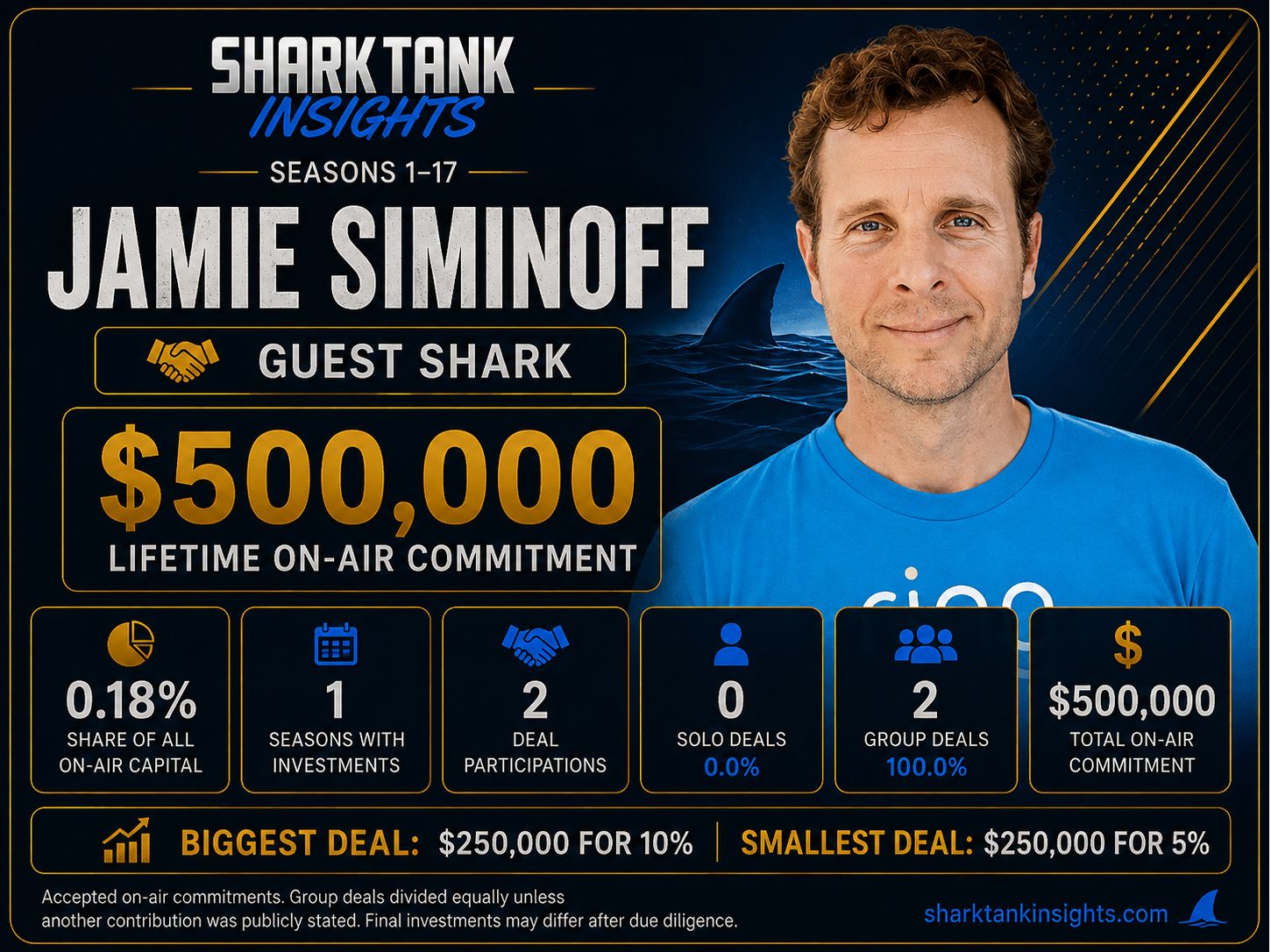
Jamie Siminoff had already tried to get money from the Sharks himself. He brought DoorBot to Shark Tank, did not get a deal, and kept working on the business anyway. DoorBot became Ring, and Amazon eventually acquired the company for more than $1 billion. Years later, Jamie was back on Shark Tank, except now entrepreneurs were asking him for the money.
There wasn’t much time for him to make investments. Jamie appeared only twice in Shark Tank Season 10. He still came away with Bear Minimum and Moink from those two appearances. Both were his own deals too, without another Shark joining him.
Bear Minimum was the smaller one at $100,000 for 25%. Then Moink came along and Jamie agreed to $400,000 for 20%. That is a pretty big jump between two deals. And with only those two companies, Jamie had already agreed to invest $500,000 on Shark Tank.
Moink is where most of that money went. The company alone got a $400,000 commitment from Jamie, leaving only $100,000 of his complete amount for Bear Minimum. Jamie had only two businesses in his Shark Tank portfolio, but they did not take anything close to the same amount of money. One of them was already four times the other.
How Much Did Jamie Siminoff Invest on Shark Tank?
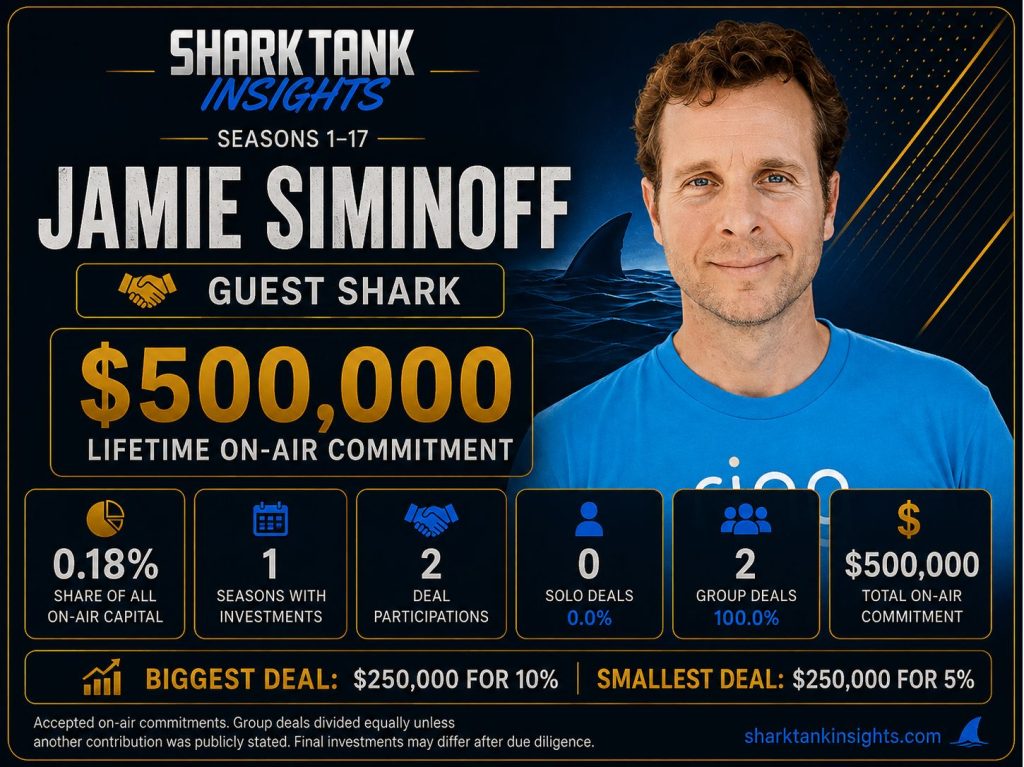
Jamie Siminoff invested $500,000 in two Shark Tank companies. His first deal was Bear Minimum, while Moink became the second company he backed alone. Both investments were made during Season 10.
| Company | Accepted Deal | Jamie Siminoff’s Commitment |
|---|---|---|
| Bear Minimum | $100,000 for 25% equity | $100,000 |
| Moink | $400,000 for 20% equity | $400,000 |
| Total | $500,000 |
Jamie’s $500,000 came from only two accepted deals. There was $100,000 for Bear Minimum and another $400,000 for Moink. He did not share either investment with another Shark. That means there is no need to cut either amount in half when counting Jamie’s money.
And both deals happened in Season 10. Jamie did not return for another season and build onto the $500,000 with more investments. Two appearances, Bear Minimum and Moink, were his complete run as an investor. He actually found a company to back on each appearance.
The problem comes when we call all $500,000 money Jamie definitely invested. Shark Tank deals can still change once filming is finished, and some never close at all. Bear Minimum continued selling its collapsible cooking products after the show, but strong evidence that Jamie’s $100,000 deal was completed has not surfaced. That leaves some uncertainty around the smaller of his two investments.
Moink is much easier to follow after the episode. Jamie remained connected with Lucinda Cramsey and the business, and he later talked about Moink being profitable and his investment paying him back. There is much more there than just Lucinda accepting his offer in the Tank. Jamie’s accepted amount is $500,000, but Moink is the deal with much stronger public support behind the money actually going in.
Jamie Siminoff’s Season 10 Investments
Jamie’s first deal came from a cooking pot. Heidi and Cory Santiago had made Bear Minimum for camping, where carrying a normal pot around can take up quite a bit of room. Their pot could collapse when they were not using it. That made it much easier to fit inside a backpack.
The two were asking for $100,000 for 20% of Bear Minimum. Jamie had spent years dealing with the problems that come after somebody has an idea for a product, including manufacturing and finding enough money to keep growing. He offered the $100,000, but wanted 25% instead. Heidi and Cory took it.
Moink was completely different from Bear Minimum. Lucinda Cramsey was selling meat from family farms and sending it directly to customers through a subscription business. Beef, pork, chicken, lamb and seafood were all part of what customers could get. Lucinda came to Shark Tank asking for $250,000 for 10%.
But Jamie did not think $250,000 was enough money for what Lucinda wanted to build. He went higher and offered $400,000 for 20% of the company. That gave Moink another $150,000 beyond what Lucinda had originally asked the Sharks for. She accepted Jamie’s offer, and his second appearance ended with his second deal.
Jamie Siminoff Invested $100,000 in Bear Minimum
How annoying is it to carry a big cooking pot when you are already packing everything for camping? Heidi and Cory Santiago came up with Bear Minimum, a cooking pot that could actually collapse. It takes up less space in the backpack and then opens up into a cooking container when it is needed. The entrepreneurs were looking for $100,000 for 20% equity.
Jamie Siminoff had already done the invention part himself. Before Ring became a much larger company, there were years of product development, manufacturing problems and trying to grow the business without having unlimited money to throw at it. Bear Minimum had some of those same early problems to get through. Jamie could understand that, even if a camping pot had very little to do with Ring.
He offered Heidi and Cory $100,000 for 25% of Bear Minimum. The extra 5% did not stop them, and they agreed to Jamie’s offer. There was no other Shark involved in the investment. So, this gives Jamie the complete $100,000 from the deal.
But did Jamie actually put the $100,000 into Bear Minimum? This is where the answer gets difficult because the company continued operating after Shark Tank, but there isn’t stronger public evidence showing the original investment was completed. Deals on the show still have to go through due diligence after the entrepreneurs leave the Tank. Therefore, Bear Minimum can be counted as Jamie’s $100,000 accepted deal, while the actual funding is not confirmed yet.
Jamie Siminoff Invested $400,000 in Moink
Moink had a different problem. Lucinda Cramsey wanted money to grow the subscription business, where customers could order meat coming from family farms. Beef, pork, chicken, lamb and seafood were included. She asked the Sharks for $250,000 for 10% of Moink.
Jamie Siminoff liked the business, but he didn’t think Lucinda was asking for enough money. She wanted to grow, and Jamie had already learned with Ring how expensive growing a company could become. Why take $250,000 if the business was going to need more money anyway? Jamie offered $400,000 for 20%.
That changed both sides of Lucinda’s original offer. She would get another $150,000, while Jamie would get twice the ownership she first planned to sell. Lucinda agreed to it. Her original $2.5 million valuation came down to about $2 million with Jamie’s offer.
And Jamie had something useful here besides $400,000. Lucinda was still trying to take Moink from a smaller company into a much bigger one, while Jamie had already done that with Ring. He knew raising money and he knew the problems that came with growing a young business. For Moink, that experience made sense.
The $400,000 was also Jamie’s money alone. He did not have another Shark joining the deal and taking part of the investment. Lucinda accepted $400,000 for 20%, giving Jamie his second solo deal in two appearances. Moink ended up taking most of the money Jamie agreed to invest during his short Shark Tank run.
What Happened to Moink After Shark Tank?
Moink was reportedly getting close to $23 million in annual sales by 2023. Around $2 million was profit. That is a pretty healthy business, especially when Lucinda Cramsey had originally gone into Shark Tank asking Jamie Siminoff and the other Sharks for $250,000. Jamie ended up giving her a bigger offer, $400,000 for 20%.
But there is something more useful than Moink’s sales when trying to figure out what happened to Jamie’s deal. Jamie was still connected with Lucinda and the company years later. He talked about Moink being profitable, and he said his investment had paid him back. Attorneys representing Jamie later discussed the investment too.
That makes Moink quite different from an accepted deal where the entrepreneur and Shark are never really connected again. Still, nobody outside the private company gets to see all of the paperwork. Moink’s ownership documents have not been made public, so we cannot say the final agreement definitely remained $400,000 for 20%. What happened during due diligence between Jamie and Lucinda stays private.
And getting his investment back does not tell us Jamie’s complete profit either. He could say the investment paid him back without telling us how much more he earned from it. Moink was making millions in sales, but those millions belonged to the business. Jamie has never publicly given an exact number for what the investment eventually made him.
Jamie Siminoff’s Shark Tank Investment Style
Jamie Siminoff had built Ring, but neither of the businesses he invested in was really a technology company. Bear Minimum sold camping cookware and Moink sold meat. Pretty far away from video doorbells. His two deals do not show somebody looking around the Tank for another Ring.
What Jamie did have in common with these entrepreneurs was building something from the beginning. He had dealt with making a product, finding money, manufacturing it and then trying to make the business much bigger. Bear Minimum was still dealing with some of those product problems. Lucinda Cramsey was trying to grow Moink and needed enough money to actually do it.
And Jamie noticed that part with Moink. Lucinda asked for $250,000, but he thought she needed more money than that. Jamie offered $400,000 for 20% instead. He was not simply deciding whether he liked the business at the number Lucinda brought into the Tank.
There are only two deals here though. Two companies are not really enough to say Jamie only liked one type of entrepreneur or had some fixed way of investing. If anything, Bear Minimum and Moink make the opposite point because the products were so different. Jamie’s technology background did not keep him inside technology when it was his turn to invest.
What Jamie Siminoff Brought to Shark Tank
Jamie Siminoff had built Ring through all the parts that come after having the idea. There was raising money, manufacturing and continuing to work on the product as the company grew. Ring also did not stay as just one video doorbell. It expanded into a much bigger home-security company.
That experience could help when an entrepreneur was dealing with some of the same problems Jamie had already been through. Jamie knew what it was like when a product was still small and needed money to get further. He had actually been the person asking the Sharks for that money before. DoorBot was his Shark Tank pitch, and he left without accepting a deal.
DoorBot became Ring after Shark Tank. Amazon later bought the company for more than $1 billion. Jamie went from not getting the Shark Tank investment he wanted to building one of the biggest businesses connected with the show. And he did it without that original deal.
By the time Amazon bought Ring in 2018, the company had grown well beyond the doorbell Jamie first brought to Shark Tank. There were years of building the business between that pitch and the acquisition. Jamie had seen what could happen to a company after the few minutes people see in the Tank. That was something he could bring with him when it was his turn to listen to the entrepreneurs.
How Successful Was Jamie Siminoff on Shark Tank?
Jamie Siminoff never really got the chance to build a big Shark Tank record. He was there twice, made two deals and then his time as a Shark was over. $500,000 between Bear Minimum and Moink. For somebody who only had two appearances, he at least did not leave either one without finding a business.
But how successful were those two investments? Bear Minimum continued after Shark Tank, although the $100,000 agreement with Jamie does not have strong support showing that it actually closed. That makes Bear Minimum difficult because the business surviving is one thing, Jamie actually being an investor in that business is another. We cannot really give him an investment win from that alone.
How Successful Was Jamie Siminoff on Shark Tank?
Jamie Siminoff never really got the chance to build a big Shark Tank record. He was there twice, made two deals and then his time as a Shark was over. $500,000 between Bear Minimum and Moink. For somebody who only had two appearances, he at least did not leave either one without finding a business.
But how successful were those two investments? Bear Minimum continued after Shark Tank, although the $100,000 agreement with Jamie does not have strong support showing that it actually closed. That makes Bear Minimum difficult because the business surviving is one thing, Jamie actually being an investor in that business is another. We cannot really give him an investment win from that alone.
Moink is much more interesting here. Jamie stayed involved with Lucinda Cramsey, and later he actually said that Moink was profitable and had paid his investment back. Since Jamie put $400,000 into the company, recovering that amount is a much better outcome than seeing the business fade away after its Shark Tank appearance. More importantly, this gives us a result tied directly to Jamie’s investment instead of simply judging Moink by its overall business performance.
The bigger question is how much profit Jamie made beyond getting his original money back. That information has not been made public, and strong sales do not automatically translate into an investor’s personal return. Jamie may have earned more from Moink, but we do not have the records to put a number on it. With Bear Minimum still uncertain and Moink paying him back, his two-deal run did produce at least one result that worked out pretty well for him.
Conclusion
Jamie Siminoff committed $500,000 across two accepted Shark Tank deals during Season 10. Moink contributed $400,000 and Bear Minimum added another $100,000. Two appearances were enough to build the complete portfolio.
Both Bear Minimum and Moink were solo deals. Jamie did not bring another Shark into either agreement, while both businesses gave him problems he could understand from his own entrepreneurial career. Jamie did not act like building Ring made him an expert in only technology companies.
Bear Minimum continued operating but its television agreement remains uncertain, while Moink developed into a real relationship with Jamie and later paid him back. However, company progress and Jamie’s personal investment return are still two different things. The exact money Jamie made from his $500,000 Shark Tank portfolio remains private.

Hi. I’m Daniyal Durrani. A CA-finalist, CPA-UK, and Master in Economics, with a decade-long business studies experience. I work as an Audit and Business Advisory Manager in a globally recognized accounting firm. I have been watching Shark Tank for a long time and have always admired the innovative business ideas. The revolutionary solutions to unaddressed day-to-day problems presented on the show used to impress me like no other thing on TV. Read more About me.