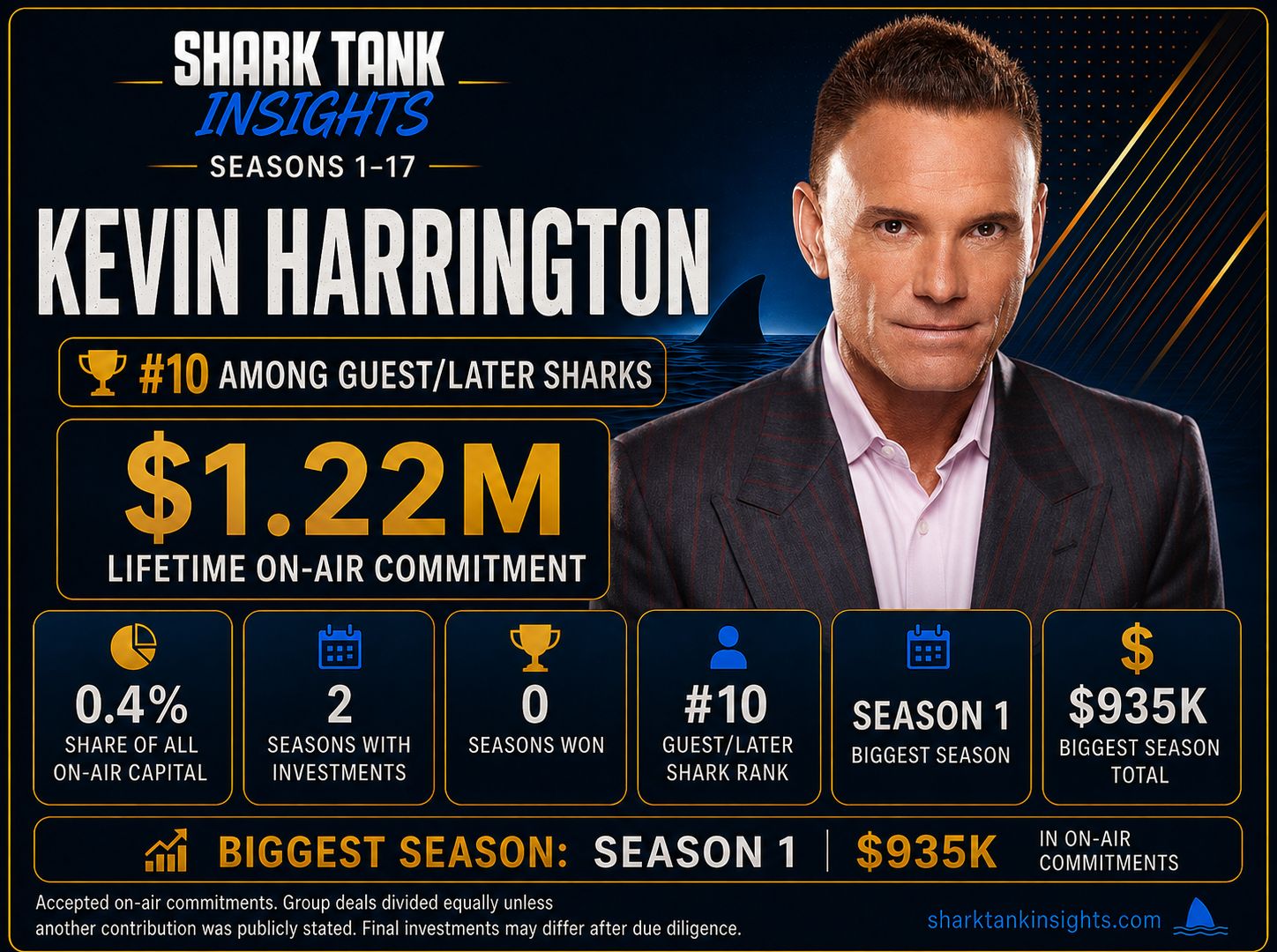
Kevin Harrington had only two seasons to make his Shark Tank deals. Season 1, Season 2, and then he was gone. Still, 13 deals had Kevin involved before his time in the Tank ended. That is quite a lot of businesses for somebody who did not stay very long.
Kevin’s part of those 13 deals comes to $1,215,000. Of course, the Sharks who stayed for ten or more seasons ended up putting much more money on the show. Kevin never had all those extra years. His complete number came from just two seasons.
And Kevin was already deep into the product business before becoming a Shark. Infomercials were a big part of his career. He had also worked in direct-response television and HSN Direct. Basically, getting a product on television and getting people interested enough to buy it was not something he was learning for the first time on Shark Tank.
A Perfect Pear got the largest share of his money. Kevin and Robert Herjavec offered $500,000 for 50%, putting Kevin’s half at $250,000. Caffeindicator came next with Kevin offering $200,000 alone.
But these are the deals accepted on television. Several of Kevin’s agreements later changed or never closed at all. That makes his $1.215 million actual investment a lot harder to pin down.
How Much Did Kevin Harrington Invest on Shark Tank?
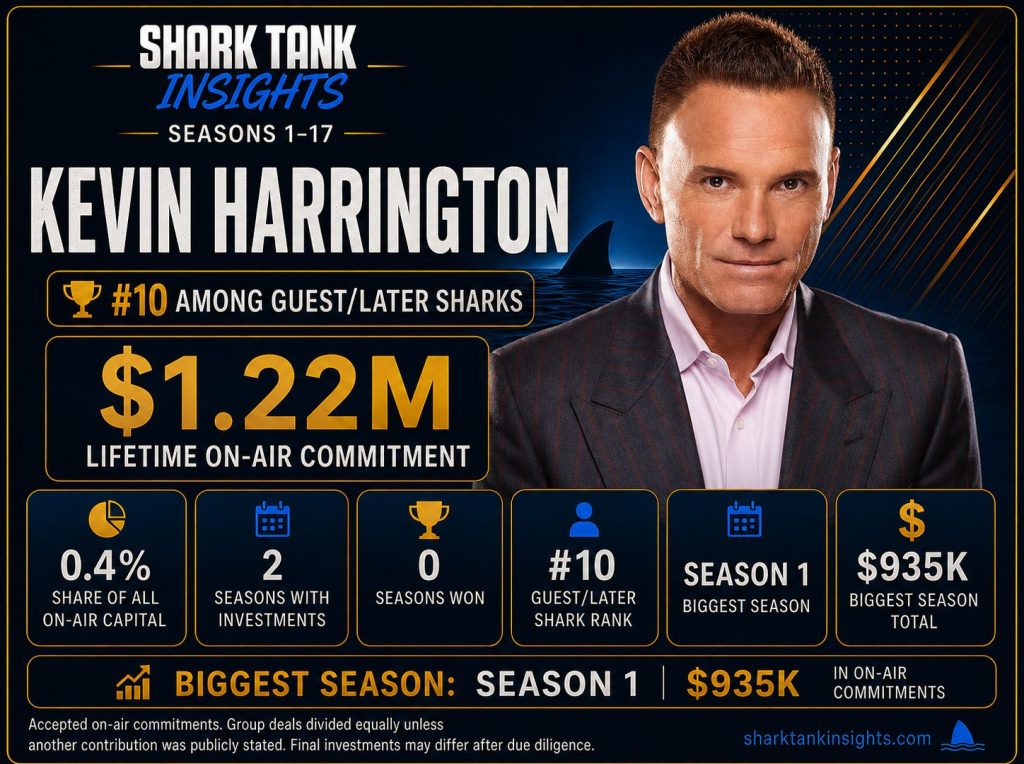
Kevin Harrington invested an attributed $1,215,000 across 13 accepted Shark Tank deals. Five were investments without another Shark, while eight agreements involved at least one partner. Every accepted commitment came during Seasons 1 and 2.
| Statistic | Kevin Harrington’s Record |
|---|---|
| Accepted on-air commitments | $1,215,000 |
| Seasons with investments | 2 |
| Accepted-deal participations | 13 |
| Solo deals | 5 |
| Group deals | 8 |
| Largest attributed commitment | $250,000 — A Perfect Pear |
| Largest solo commitment | $200,000 — Caffeindicator |
| Biggest season | Season 1 — $935,000 |
| Average commitment | Approximately $93,462 |
| Median commitment | $90,000 |
Season 1 was where Kevin Harrington did most of his Shark Tank investing. He got into nine deals during that season, and Kevin’s part of the money reached $935,000. Then Season 2 added only another $280,000. Quite a drop from his first year.
Fridge Fronts, Sweep Easy, CitiKitty and Aldo Orta Jewelry were the four Season 2 deals. After those, Kevin did not come back for another season. So, $935,000 from the first season and $280,000 from the second gives us his complete $1,215,000 accepted amount.
There were also more group deals than solo ones. Kevin invested alone in TurboBaster, Element Bars, UroClub, Caffeindicator and CitiKitty. Five businesses. The other eight had another Shark involved.
The eight group deals make the number a little trickier. Kevin could be part of a large deal without actually putting up all of that money himself. Another Shark was paying part of it too. So, only Kevin’s side of those deals goes into his $1.215 million.
His five solo deals are much simpler. Nobody else was sharing the investment with him. Whatever Kevin agreed to put into those businesses was his money, and the complete amount goes under his name.
Kevin Harrington’s Average Shark Tank Investment
Kevin Harrington had only two seasons to make his Shark Tank deals. Season 1, Season 2, and then he was gone. Still, 13 deals had Kevin involved before his time in the Tank ended. That is quite a lot of businesses for somebody who did not stay very long.
Kevin’s part of those 13 deals comes to $1,215,000. Sharks who stayed for ten seasons or more obviously put a lot more money into the show over the years. Kevin never had those extra years, so whatever he invested came out of just two seasons.
He had also already spent years in the product business before Shark Tank. Infomercials were a big part of his career. Direct-response television too, and HSN Direct. Getting a product on screen and getting somebody to actually reach for their wallet, that wasn’t a new skill for him.
A Perfect Pear took the biggest chunk of his money. He and Robert Herjavec offered $500,000 for 50%, so Kevin’s half comes to $250,000. Caffeindicator was his, alone, $200,000.
Not every deal held up after the cameras stopped rolling though. Some of Kevin’s agreements changed later. A few never closed at all. So $1.215 million is really just the number from inside the Tank, not necessarily what ended up leaving his account.
A Perfect Pear Was Kevin Harrington’s Largest Shark Tank Investment
A Perfect Pear put $250,000 beside Kevin’s name, more than any of his other Shark Tank deals. Susan Knapp had a gourmet food business, and Kevin and Robert Herjavec offered her $500,000 for half of it. Kevin’s share of that offer was $250,000.
Things did not stay that way though. Robert reportedly left the deal after Shark Tank, but Kevin kept working with Susan. A Perfect Pear later made it onto HSN with Kevin’s help. And HSN was already a big part of Kevin’s world before Shark Tank. Selling products there was something he knew.
So, while Kevin is credited with $250,000 based on the accepted deal structure, that may not reflect what he ultimately invested. His earnings from A Perfect Pear have not been publicly disclosed.
Caffeindicator Was Kevin Harrington’s Largest Solo Deal
Caffeindicator gave Kevin a $200,000 deal all to himself. That was more money than he agreed to put into any of his other solo investments. Only his $250,000 share of A Perfect Pear was larger, and Robert was part of that one.
Caffeindicator’s idea was simple: it was designed to indicate whether a drink contained caffeine. Kevin liked the business enough to offer $200,000, but he didn’t commit the money without conditions. A deal with a major company first had to be secured.
That never happened.
As a result, Kevin’s investment never closed. The $200,000 remained a Shark Tank offer rather than becoming actual funding for Caffeindicator.
This one matters quite a bit when looking at Kevin’s numbers because $200,000 is not a small part of his complete $1.215 million. It is almost one-sixth of everything attributed to him from his 13 accepted deals. Yet none of that Caffeindicator money can be counted as a completed investment.
So, Kevin did make a $200,000 offer and the entrepreneur accepted it in the Tank. The condition attached to the deal just stopped it from getting any further.
CitiKitty Became Kevin Harrington’s Best-Known Deal
CitiKitty was probably not the most normal product Kevin saw in the Tank. Rebecca Rescate had made a kit to train cats to use the toilet. No litter box after the training was done. For anybody who has a cat and is tired of dealing with litter, that is a pretty easy benefit to understand.
Kevin went for it. He offered Rebecca $100,000 for 20% equity, and she accepted. There was no second Shark in this deal, which means Kevin gets the whole $100,000 in his investment total.
It was actually his only solo deal from Season 2. The other three businesses Kevin backed that season all had another Shark involved.
CitiKitty continued to show long-term success. The training kits kept selling after Shark Tank, and the business stayed active for several years. This helped it remain a product that people still linked to Kevin even after he had moved on from the show.
Even before Shark Tank, Kevin had spent years dealing with products that required strong visual demonstrations, and CitiKitty was a perfect example of that experience. When you demonstrate the training system and a cat successfully using a toilet, there is not much more that needs to be said. It was a unique idea, yet Kevin had already built his career around introducing unconventional consumer products to the market.
Kevin Harrington’s On-Air Investments Vs Actual Investments
Jesus needed to explain what he planned to do with the investment money. He told the Sharks they hadn’t done any marketing yet, so the funds would help them reach the right audience more efficiently. He also wanted to buy a digital press to print in-house, which would increase profit by fourteen cents per card.
Kevin stayed out of the deal because he already partnered with a similar business, though he called it a great enterprise. Then Daniel offered $120,000 for a 35% stake. Barbara didn’t want Jesus to make any deal at all. She believed meddling with his authentic creative process might cause some harm. Mark agreed with her and backed out. But Lori thought the business could do even better with someone like Daniel.
Suddenly, Mark changed his mind. He stepped back in and offered $120,000 for 20% equity, and Jesus gladly accepted.
After the episode aired, the company started capturing significant internet attention. Social media buzzed with discussions about the unique cards, while Google Trends reflected a sharp rise in searches. The estimated net worth of Paper Tacos now lands between $650,000 and $772,000. Customers looking for a change from boring traditional cards can buy them directly from the official website.
Kevin Harrington’s Shark Tank Investment Style
Kevin brought a very different kind of experience to the Tank compared to the other original investors. He had spent decades working with direct-response television and distribution. Taking a simple consumer product and turning it into a business through demonstrations was something he already knew how to do.
That background could be extremely useful for an entrepreneur selling a physical product. Inventing something useful is only one challenge. Convincing millions of strangers to actually understand it and buy it is another game entirely. Kevin had already experienced both.
He also understood the importance of presentation. Direct-response products don’t succeed just because an invention is impossible to copy. Customers need to see the problem and the benefit quickly. This gave Kevin an advantage with products that needed a demonstration rather than more technology. A simple invention can easily disappear if buyers have no idea why they even need it.
Kevin knew how marketing could solve that problem. CitiKitty, Sweep Easy and Body Jac needed a lot of those exact skills. The products were easy enough to understand, but the future of each business depended on getting the demonstration in front of enough customers. He had spent years dealing with exactly this.
So his value as a Shark wasn’t measured only through the money he invested. Kevin could help a founder understand how a simple consumer invention turns into a product people actually buy. That kind of experience is pretty difficult to put on a valuation sheet.
What Kevin Harrington Brought to Shark Tank
Does an entrepreneur only need the money? Kevin Harrington was one of the original investors on Shark Tank, but what he brought to the show was actually quite different from the others. He had already spent decades taking simple consumer products and turning them into real businesses. He did this mostly through direct-response television and demonstrations.
For anyone selling a physical product, that kind of experience is huge. It is one thing to invent something useful. Convincing millions of complete strangers to actually buy it is a completely different challenge. Kevin had already spent years doing exactly that.
He understood how presentation works. With direct-response products, it isn’t about having impossible-to-copy technology. Customers just need to see the problem and understand the benefit right away. If people don’t know why they need a simple invention, it just disappears. Kevin knew how marketing could solve that.
You look at businesses like CitiKitty, Body Jac or Sweep Easy. The products were easy enough to understand. But for those businesses to survive, they needed to get their demonstration in front of enough customers. Kevin had already been dealing with exactly that kind of problem for a long time.
So his real value as a Shark wasn’t only measured by the amount of money he invested. Kevin could actually help an entrepreneur figure out how to take a simple invention and make it into something people actually buy. That kind of experience is difficult to place on a valuation sheet.
Kevin Harrington’s Business Career Beyond Shark Tank
Kevin Harrington had already spent years around products before Shark Tank. Infomercials were a big part of it, but then there was direct-response television and HSN Direct too. He was not only putting products on TV. There were other parts of the business around them.
Manufacturing was part of it. Product development was part of it. Distribution and financing too. Quantum International became another part of Kevin’s business career.
And there were a lot of products. His official biography says he has been involved with more than 500 product launches. You don’t get to that number by doing a few infomercials and moving on.
Television was useful because people had to see the product first. Kevin had been doing that for years. Then the product had to actually get to customers, which is where the other parts of his business came in. That was already Kevin’s world before Shark Tank.
The money from Shark Tank was much smaller when you look at everything else. Kevin had $1.215 million attributed to his 13 accepted deals on the show. That came from only two seasons.
Companies connected with his career reportedly generated billions of dollars in global sales. So the $1.215 million is a real number from his Shark Tank career, but it does not tell you how big Kevin’s business career was outside the show.
How Successful Was Kevin Harrington on Shark Tank?
Thirteen deals is not a huge Shark Tank portfolio, but Kevin Harrington was only there for two seasons. His part of those accepted deals reached $1.215 million. Then he left the show. He never got another ten seasons to keep adding businesses and money to that number.
The results from those businesses are all over the place too. CitiKitty did pretty well after Shark Tank and continued selling for years. A Perfect Pear had a more unusual story. The original deal with Kevin and Robert did not stay the same, but Kevin continued working with Susan Knapp and helped get the products onto HSN.
Other deals didn’t get that far. Some of Kevin’s agreements never closed after filming. That makes the word successful a little tricky here. CitiKitty continuing for years is a good result. Kevin continuing his relationship with A Perfect Pear is another. But neither one tells us how much money eventually came back to Kevin.
And that number is really what we would need if we wanted to know how profitable his Shark Tank investments were. A company can keep running and selling products without giving an investor a big return. Kevin could make money from an exit or receive money from the business in other ways, but those details are private.
Therefore, we know much more about what happened to Kevin’s companies than what happened to his money. His accepted deals gave him a $1.215 million Shark Tank portfolio. His actual profit from it has never been publicly shared.
Conclusion
Thirteen accepted deals in two seasons is actually quite a bit when Kevin Harrington did not get all the years the other original Sharks did. And most of those deals came immediately. Nine in Season 1. By the time that season was over, Kevin had already agreed to $935,000 as his part of the investments.
Season 2 was different. There were only four deals this time, adding $280,000. Then Kevin was no longer on Shark Tank. Altogether, the two seasons put him at $1.215 million.
But there were 13 deals and only five that Kevin did by himself. The rest had other Sharks putting money in too. For an entrepreneur, that could mean getting help from more than one person. Different Sharks knew different businesses.
Kevin already knew a lot about selling physical products himself. Direct-response television had been a huge part of his career. If a product needed to be demonstrated and then sold to a large number of people, Kevin had been doing that kind of work long before he entered the Tank.
The $1.215 million still needs to be treated carefully though. Shark Tank agreements can look very different once filming is over. Element Bars did not continue with Kevin. Caffeindicator’s $200,000 deal never happened after its condition was not met. Sweep Easy also did not end up with the original agreement.
That leaves no exact public number for Kevin’s real complete investment. There is also no reliable number showing how much profit those Shark Tank businesses eventually made for him.

Hi. I’m Daniyal Durrani. A CA-finalist, CPA-UK, and Master in Economics, with a decade-long business studies experience. I work as an Audit and Business Advisory Manager in a globally recognized accounting firm. I have been watching Shark Tank for a long time and have always admired the innovative business ideas. The revolutionary solutions to unaddressed day-to-day problems presented on the show used to impress me like no other thing on TV. Read more About me.