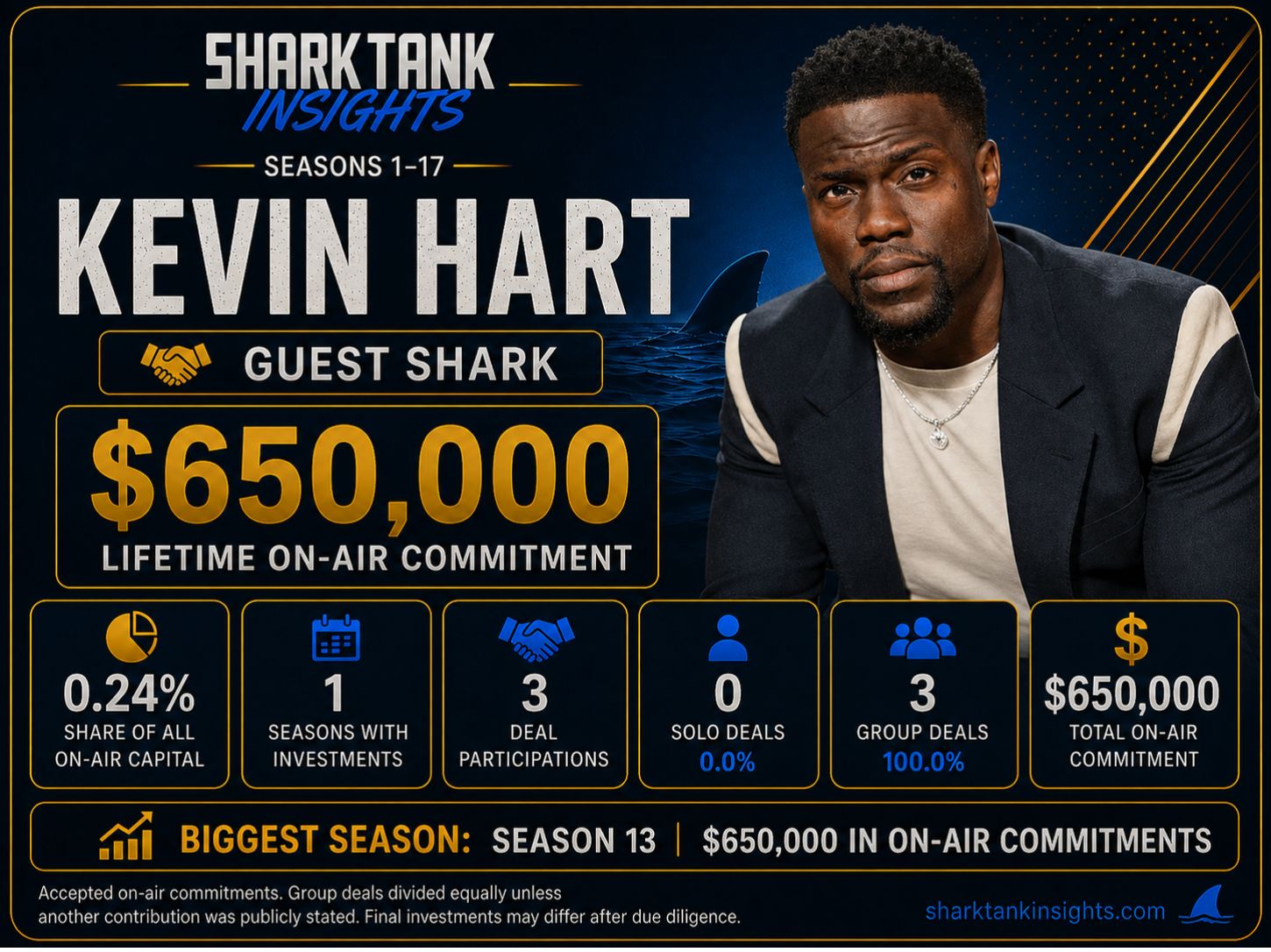
Kevin Hart entered Shark Tank Season 13 with years of entertainment and business experience behind him. He was already popular for comedy, movies and television before sitting in the guest Shark chair, but his career had also expanded into production, consumer businesses and private investments. Therefore, Kevin did not come on the show only with money because he had spent years building audiences, brands and entertainment businesses.
However, Kevin did not remain on Shark Tank long enough to build a big portfolio. He appeared twice and made three accepted investments in Snactiv, Black Sands Entertainment and The Transformation Factory. His attributed investment from the three companies came to $650,000.
Kevin also did not make a solo investment during his time on Shark Tank. His three accepted deals all involved another Shark, so he finished the show with three group investments and zero solo deals. Lori Greiner joined him on Snactiv, while Mark Cuban became his partner on Black Sands Entertainment and The Transformation Factory.
The $650,000 figure has another problem that should not be ignored. It represents the money accepted by entrepreneurs inside the Tank, but Snactiv does not have the same closing evidence as Black Sands Entertainment and The Transformation Factory. Therefore, Kevin’s accepted Shark Tank investment and his publicly supported actual investment should not be considered the same number.
How Much Did Kevin Hart Invest on Shark Tank?
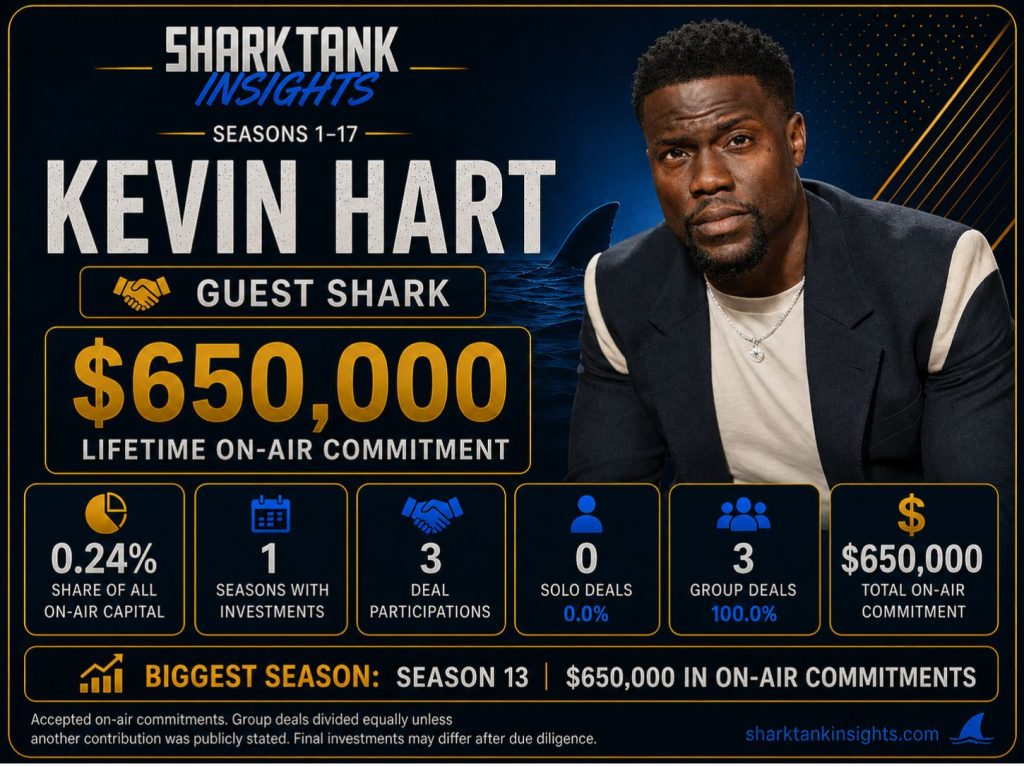
Kevin Hart invested an attributed $650,000 in three Shark Tank companies. Snactiv was his first deal with Lori Greiner, while Black Sands Entertainment and The Transformation Factory came with Mark Cuban. All three investments happened during Season 13.
| Company | Accepted Deal | Kevin Hart’s Attributed Commitment |
|---|---|---|
| Snactiv | $200,000 for 20% equity | $100,000 |
| Black Sands Entertainment | $500,000 for 30% equity | $250,000 |
| The Transformation Factory | $600,000 for 20% equity | $300,000 |
| Total | $650,000 |
The calculation does not have much complication either. Every agreement involved Kevin and one other Shark, while no different cash contribution was publicly disclosed. This gives Kevin $100,000 from Snactiv, $250,000 from Black Sands Entertainment and another $300,000 from The Transformation Factory.
The Transformation Factory became Kevin Hart’s largest attributed Shark Tank investment at $300,000. Black Sands Entertainment sits slightly behind with $250,000, while Snactiv added the remaining $100,000. Only $50,000 separated Kevin’s two biggest investments.
Kevin Hart Invested $100,000 in Snactiv
Kevin Choi and Edwin Cho entered Shark Tank with Snactiv, a small tool designed to sit between someone’s fingers while eating snacks. The product allowed gamers, office workers and other customers to eat without constantly getting food residue on keyboards, controllers or phones. The founders demanded $200,000 for 10% equity.
The product addressed a simple problem that anyone eating around electronics could understand. Snactiv sat between the fingers and allowed customers to grab food without using the same fingers touching their devices. It was not a life-changing invention, but convenience products do not always need rocket science to find customers.
Marketing was an area where Kevin could become useful. Lori had years of experience around physical products and retail, while Kevin could help on the consumer side with attention and marketing. Suddenly, the weaknesses of one Shark could be covered by the strengths of the other.
Kevin and Lori eventually offered $200,000 for 20% equity. The founders tried bringing the ownership percentage down, but both Sharks remained at 20%. Kevin Choi and Edwin eventually accepted, giving Kevin an attributed commitment of $100,000.
However, the final deal status remains unclear. Snactiv continued operating after Shark Tank, but there is no strong public evidence showing that Kevin and Lori ultimately completed the investment. Therefore, the $100,000 remains part of Kevin’s accepted Shark Tank commitment rather than publicly supported actual investment.
This does not automatically mean Kevin walked away from Snactiv. Final Shark Tank contracts are private, and entrepreneurs do not always announce everything that happens after filming. Without stronger evidence, assuming the deal either closed or failed would be guesswork.
Kevin Hart Invested $250,000 in Black Sands Entertainment
Manuel and Geiszel Godoy entered Shark Tank with Black Sands Entertainment, a company built around comics, graphic novels, animation and stories centered on Black history and characters. The founders wanted to build something much larger than another comic publisher. They demanded $500,000 for 5% equity.
Black Sands Entertainment was much closer to Kevin Hart’s playground. Manuel and Geiszel wanted to build entertainment around characters, stories and intellectual property. Kevin had already gone through the pain of building entertainment businesses and finding audiences for different types of content.
However, the founders needed more than good comic books to justify a much larger business. Publishing can create revenue, but one collection of books can limit how far an entertainment company goes. The intellectual property was therefore the strongest part of the opportunity.
If the characters work across animation, television, movies and licensing, Black Sands can open completely different markets. If they only work well enough to sell comics and graphic novels, the possibilities become much smaller. This is where Manuel and Geiszel have to prove that Black Sands is an entertainment business rather than only a comic publisher.
Manuel and Geiszel entered Shark Tank asking for $500,000 for 5% equity. The demand placed a $10 million valuation on Black Sands Entertainment. Kevin and Mark eventually offered the same $500,000 for 30% of the company.
The founders eventually accepted. The agreement reduced the implied valuation to approximately $1.67 million, while Kevin received an attributed $250,000 commitment for around 15% equity under an equal split. Kevin and Mark basically increased their ownership without putting another dollar into the complete deal.
There is also strong public evidence suggesting that the investment continued after the episode. Black Sands later announced that its agreement with Kevin and Mark officially closed, while the company continued selling comics and developing its entertainment properties. The television agreement did not simply disappear after filming.
Kevin Hart Invested $300,000 in The Transformation Factory
Alexiou Gibson entered Shark Tank with The Transformation Factory, a wellness company selling sea moss gels and related products. The company eventually became Kevin Hart’s largest accepted investment on the show. Alexiou demanded $500,000 for 5% equity.
The Transformation Factory was much closer to an area Kevin already understood. He had spent years around fitness, exercise, nutrition and wellness before entering the Tank, while VitaHustle gave him direct experience with a nutrition business. The Transformation Factory was therefore close to a customer Kevin already knew.
Kevin also understood the product personally because he was already familiar with sea moss. He did not need Alexiou to spend half the pitch explaining why someone interested in health and fitness might care about the product. The Transformation Factory basically found a Shark who already understood why the company existed.
However, Kevin was not ready to invest alone. He initially offered $500,000 for 20% equity and tried bringing Barbara Corcoran into the agreement. When the discussion changed, Kevin eventually moved toward Mark Cuban instead.
Kevin and Mark eventually offered $600,000 for 20% equity. Alexiou accepted, giving Kevin an attributed $300,000 commitment for approximately 10% of the company. The Transformation Factory became Kevin Hart’s largest Shark Tank investment.
There is also strong public evidence behind this deal after filming. The Transformation Factory investment was later reported as completed, giving Kevin’s $300,000 much stronger support as actual investment. The television agreement did not simply disappear after the episode.
Kevin Hart’s Accepted Vs Actual Shark Tank Investments
Kevin Hart’s $650,000 Shark Tank investment figure tells only one side of the story. The amount represents the three accepted offers divided equally between Kevin and the Sharks who partnered with him. It does not mean that $650,000 definitely left Kevin’s bank account after filming.
Snactiv contributes $100,000 to his television total, but the deal does not have strong closing support. Therefore, this amount should remain uncertain when we discuss publicly supported actual investment. Kevin was ready to invest the money, but the post-show evidence does not confirm that everything was completed.
Black Sands Entertainment contributes another $250,000 and has much stronger evidence behind it. The company publicly announced that its agreement with Kevin and Mark closed, while The Transformation Factory was also reported as completed. Considering this evidence, at least $550,000 can reasonably be treated as publicly supported completed funding.
So basically, Kevin Hart has $650,000 in accepted Shark Tank commitments and at least $550,000 in publicly supported actual investment. Approximately 84.6% of his television portfolio has stronger completion evidence. It is a small portfolio, but it perfectly shows why a Shark Tank deal and an actual investment are not always the same thing.
Kevin Hart’s Shark Tank Investment Strategy
Three Shark Tank deals are not enough to judge Kevin Hart’s complete investment strategy. However, all three investments showed one thing clearly: Kevin wanted to know what he could actually bring to the business. Writing a cheque was not enough reason for him to join a company.
Marketing and consumer attention were two areas where Kevin trusted his abilities. This was one reason the Snactiv partnership made sense because Lori could handle more of the physical-product and retail side. Kevin could work around the customer, where his popularity and marketing experience were much more useful.
Black Sands Entertainment followed another version of the same pattern. Kevin understood entertainment, but Mark Cuban brought years of broader investing and business experience into the agreement. Instead of pretending to know everything, Kevin was comfortable putting another investor beside him.
This explains why Kevin did not make a single solo Shark Tank investment. Every time, he worked with another Shark who could complement what he already brought. It might look less aggressive than going alone, but finding the right partner can sometimes make the complete deal stronger.
What Kevin Hart Brought to Shark Tank
Kevin brought something to Shark Tank that was easy to underestimate because of his comedy and acting career. He understood consumer attention, entertainment, marketing and how rapidly a small company could grow if it entered the right audience. His businesses outside the show had already taught him to look beyond what a company was worth today.
His celebrity could still be valuable to consumer brands. A recommendation, social-media mention or marketing idea from Kevin had the potential to put a small company in front of millions of people. However, publicity works much better when it supports an already workable business instead of trying to save a weak one.
Kevin was also not simply another celebrity invited to occupy a Shark chair. Hartbeat Ventures gave him experience putting money behind businesses across consumer products, technology, health and wellness. Shark Tank simply brought some of that investing activity in front of television cameras.
Kevin Hart’s Business Career Beyond Shark Tank
Kevin Hart built Hartbeat around entertainment outside the show. The company operates across film, television, digital media, branded entertainment and other forms of content. Hartbeat basically turned Kevin’s experience with media and celebrity into an actual business.
This experience also explains why Black Sands looked interesting to Kevin. Much of Hartbeat’s business involves creating entertainment and finding audiences around content. Therefore, Kevin could naturally look beyond comic books and think about where the characters might travel next.
Kevin also used Hartbeat Ventures to invest in other entrepreneurs. The portfolio has included businesses across technology, consumer products, health and wellness, including companies such as Function Health, ElevenLabs, SweatPals and VitaHustle. Instead of building every company himself, Kevin could provide capital to founders working in areas where his wider network might help.
VitaHustle and Gran Coramino added another side to the story. One pushed Kevin further into nutrition and wellness, while the other gave him ownership in a consumer alcohol brand. The comedian was no longer earning money only when someone paid him to perform.
How Successful Was Kevin Hart on Shark Tank?
Kevin Hart’s Shark Tank performance is difficult to rate because the sample size is tiny. He made only three accepted investments worth an attributed $650,000 and never remained on the show long enough to build a larger portfolio. Comparing this record with regular Sharks who watched hundreds of pitches would not make much sense.
The three companies also produced different evidence afterward. Black Sands Entertainment and The Transformation Factory developed into publicly supported completed investments, while Snactiv continued operating without the same confirmation behind Kevin’s deal. Therefore, the result looks encouraging rather than perfect.
We also have no reliable information showing exactly what Kevin financially earned from any of them. A company can continue operating while an investor still makes little or nothing if there is no exit, dividend or other cash return. Therefore, calling Black Sands or The Transformation Factory highly profitable Kevin Hart investments without private financial records would be guesswork.
His Shark Tank success is better judged through the companies and relationships instead of pretending we know his return. Two investments have strong public evidence extending beyond filming, while the third company also continued operating. For only three companies, Kevin could have done much worse.
Conclusion
Kevin Hart committed $650,000 across three accepted Shark Tank deals during Season 13. He invested an attributed $100,000 in Snactiv alongside Lori Greiner, $250,000 in Black Sands Entertainment with Mark Cuban and another $300,000 with Mark in The Transformation Factory. Every deal Kevin made on the show involved another Shark.
The Transformation Factory was the biggest investment at $300,000. Black Sands Entertainment contributed another $250,000, while Snactiv remained the smallest at $100,000. Three companies were enough to build Kevin’s complete Shark Tank portfolio.
However, the $650,000 should not be blindly called a confirmed actual investment. Black Sands Entertainment and The Transformation Factory support at least $550,000 in completed funding, while Snactiv remains uncertain. Without the final private documents, we can only work with what is publicly supported.
Kevin’s Shark Tank story is also small compared with the rest of his career. He built Hartbeat, expanded into venture investing and developed ownership in businesses outside entertainment. Shark Tank was only one small part of a much bigger entertainment and business career.

Hi. I’m Daniyal Durrani. A CA-finalist, CPA-UK, and Master in Economics, with a decade-long business studies experience. I work as an Audit and Business Advisory Manager in a globally recognized accounting firm. I have been watching Shark Tank for a long time and have always admired the innovative business ideas. The revolutionary solutions to unaddressed day-to-day problems presented on the show used to impress me like no other thing on TV. Read more About me.