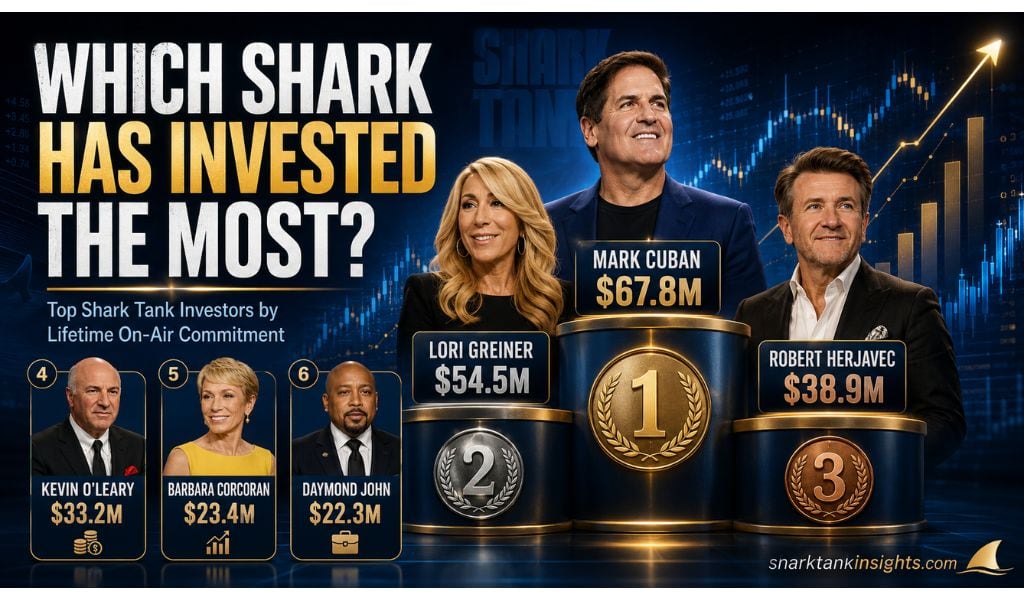
After 17 seasons, hundreds of business pitches and almost $275 million in accepted on-air financing, Mark Cuban is the only Shark who has invested considerably more than the others.
I calculated every accepted investment offer from Seasons 1 through 17. According to the data, Mark Cuban committed $67.81 million during his time on Shark Tank. This puts him more than $13 million ahead of Lori Greiner, who ranks second on the list.
However, there is an important reality behind these figures. A deal accepted on television is not always a completed investment. Once filming ends, the Sharks conduct due diligence and review the company’s finances, sales records, ownership structure, debts and legal documents. Some deals close under the original terms, while others are changed or cancelled completely.
Therefore, this article answers two separate questions:
- Which Shark committed the most money through accepted deals on television?
- Which Shark actually invested the most money after due diligence?
The first question can be answered with reasonable accuracy. The second cannot be answered completely because the final agreements and funding records of many private companies were never publicly disclosed.
Across Seasons 1 through 17, the Sharks committed $274.81 million through accepted deals shown on television. Mark Cuban accounted for $67.81 million, which represents almost one-quarter of all the financing announced on the show.
Lifetime On-Air Investment Ranking
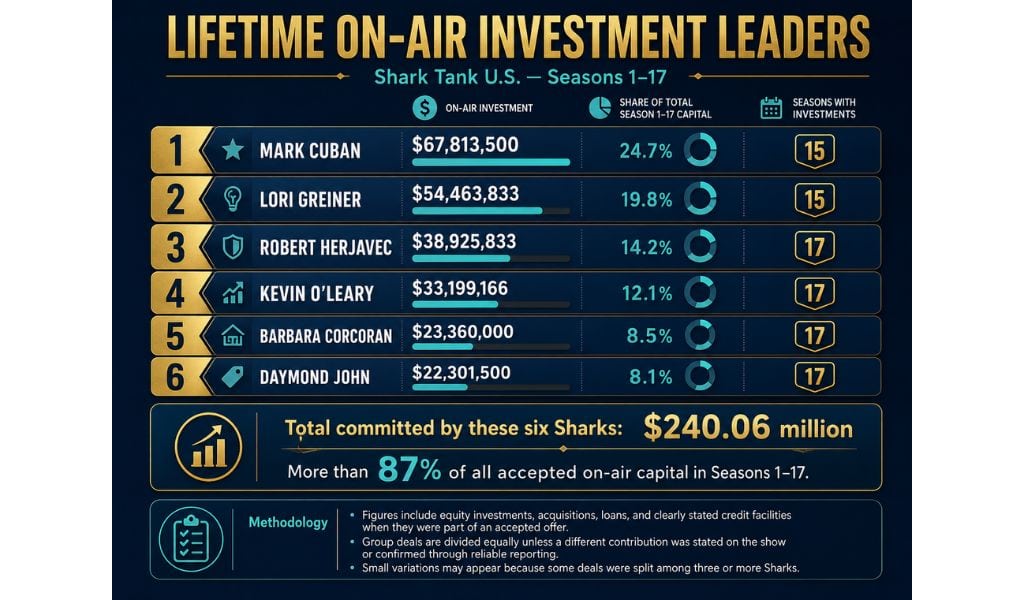
| Rank | Shark | On-air commitment | Share of Season 1–17 capital | Seasons with investments |
|---|---|---|---|---|
| 1 | Mark Cuban | $67,813,500 | 24.7% | 15 |
| 2 | Lori Greiner | $54,463,833 | 19.8% | 15 |
| 3 | Robert Herjavec | $38,925,833 | 14.2% | 17 |
| 4 | Kevin O’Leary | $33,199,166 | 12.1% | 17 |
| 5 | Barbara Corcoran | $23,360,000 | 8.5% | 17 |
| 6 | Daymond John | $22,301,500 | 8.1% | 17 |
Together, these six long-serving Sharks committed $240.06 million. This represents more than 87% of all accepted on-air capital during the first 17 seasons. The figures include equity investments, acquisitions, loans and clearly stated credit facilities when they formed part of an accepted offer.
Group deals are divided equally between the participating Sharks unless a different contribution was mentioned on the show or confirmed through reliable reporting. A small variation may appear because some investments were divided between three or more Sharks.
1. Mark Cuban — $67.81 Million
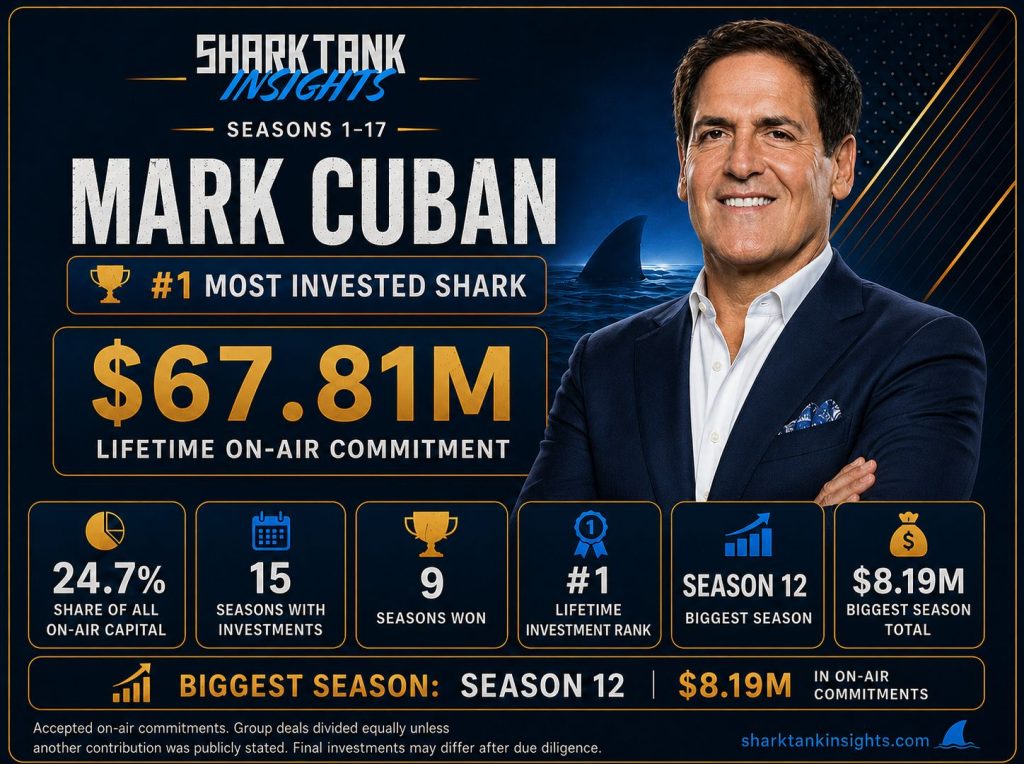
Mark Cuban is the clear lifetime investment leader on Shark Tank. He first appeared as a guest Shark during Season 2 before becoming a regular investor. He remained on the panel through Season 16. Across those 15 seasons, Cuban accumulated $67.81 million in accepted on-air commitments. He also finished as the season’s leading investor nine times:
No other Shark finished first in more than five seasons.
Why Mark Cuban Ranks First
Mark Cuban regularly invested in businesses that could grow beyond a single shop, product or location.
His portfolio included:
- Technology companies
- Education businesses
- Food and beverage brands
- Direct-to-consumer products
- Entertainment businesses
- Online services
Cuban was also willing to make some of the largest offers on the show. His biggest season was Season 12, when his accepted investment and financing commitments reached $8.19 million.
That season included Numilk’s initial investment and optional financing, SparkCharge, LARQ and several other accepted agreements.
Notable Mark Cuban Investments
Some of Mark Cuban’s best-known completed or continuing investments include:
- Tower Paddle Boards: $150,000
- Prep Expert: $250,000
- BeatBox Beverages: $1 million
- MUSH: $300,000
- Fat Shack: $250,000
- Ten Thirty One Productions: $2 million
- Rugged Maniac: $1.75 million
Mark Cuban’s $67.81 million total does not mean that every accepted agreement closed. Like the other Sharks, some of his television deals were cancelled or renegotiated after filming.
However, his combination of large investments, frequent deals and nine-season victories makes him the undisputed leader in accepted on-air capital.
2. Lori Greiner — $54.46 Million
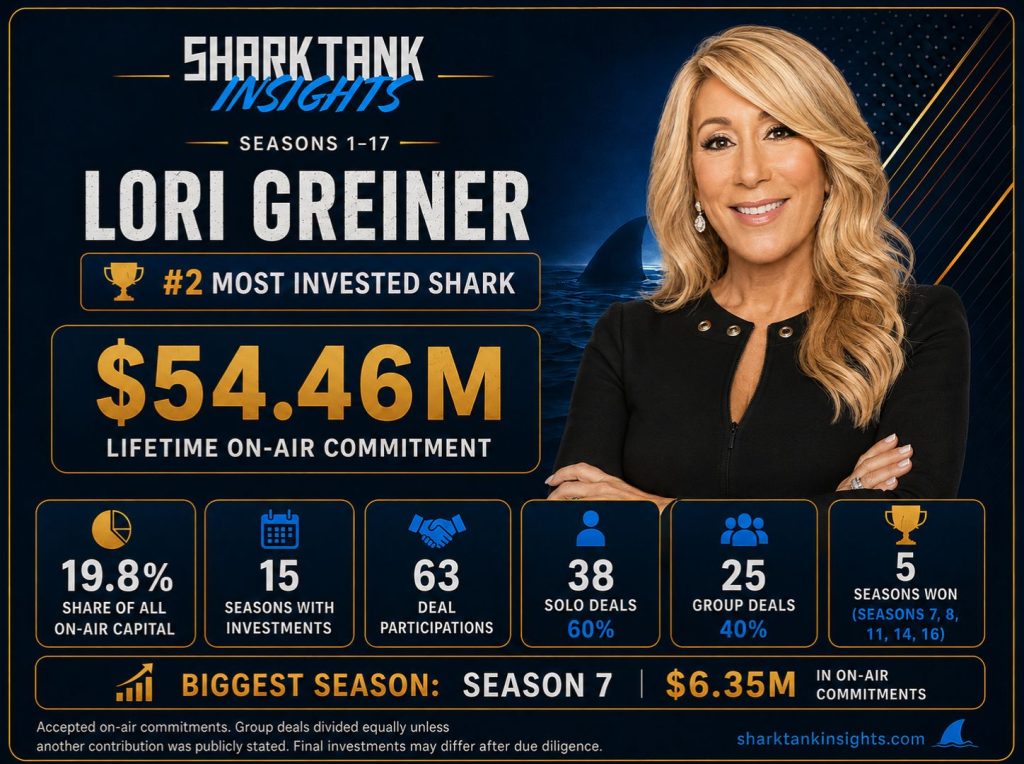
Lori Greiner ranks second with $54.46 million in accepted on-air commitments. She first appeared during Season 3 and later became one of the most active and successful investors on the program.
Lori finished as the leading investor in five seasons:
- Season 7
- Season 8
- Season 11
- Season 14
- Season 16
Her closest victory came during Season 7. Lori committed $6.35 million, beating Mark Cuban by only around $58,333. She also participated in 25 accepted deals during the season, making her the most active Shark that year.
Lori returned to the top during Season 16 with $3.89 million. She also tied Mark Cuban for the most accepted-deal participations during the season.
Why Lori Greiner Ranks So Highly
Lori Greiner’s main strength is identifying products that are easy to demonstrate and can be sold to a large consumer market.
She frequently invests in:
- Household products
- Beauty products
- Personal-care brands
- Kitchen inventions
- Health and wellness businesses
- Retail-friendly consumer products
Her QVC and retail experience gives her an advantage when entrepreneurs need help with:
- Packaging
- Product demonstrations
- Manufacturing
- Retail distribution
- National sales
Notable Lori Greiner Investments
Lori’s portfolio includes several of the most recognizable businesses in Shark Tank history:
- Scrub Daddy: $200,000 for 20%
- Squatty Potty: $350,000 for 10%
- Everlywell: $1 million for 5%
- Bantam Bagels: $275,000 for 25%
- ReadeREST: $150,000
- Simply Fit Board: $125,000
Lori’s cumulative total is $13.35 million below Mark Cuban’s. However, she remains the only Shark who regularly came close to matching Cuban in both investment amount and deal activity.
3. Robert Herjavec — $38.93 Million
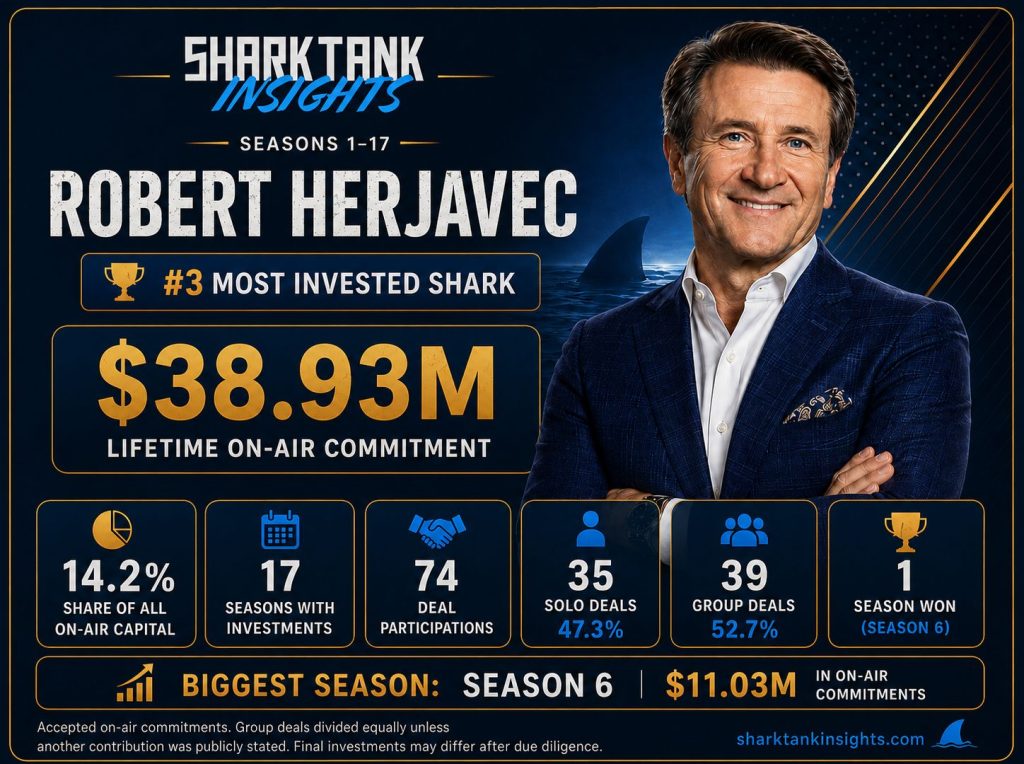
Robert Herjavec ranks third with $38.93 million in accepted on-air commitments. However, his total requires more explanation than the figures for Mark Cuban and Lori Greiner. Robert won the Season 6 investment leaderboard after committing $11.03 million.
However, $8 million of that amount came from two enormous offers:
- Zero Pollution Motors: $5 million
- SynDaver Labs: $3 million
Neither deal closed under the terms accepted on television. Without these two offers, Robert’s Season 6 total would have fallen from $11.03 million to only $3.03 million. This example shows how one or two large failed deals can significantly increase a Shark’s on-air investment total.
Robert Herjavec’s Investment Style
Robert normally favors companies with:
- Strong founders
- Defensible technology
- Premium products
- Licensing potential
- Clear growth opportunities
- A convincing brand story
He is also willing to make large conditional offers when he believes a company has the potential to become a major business.
Notable Robert Herjavec Investments
Some of Robert’s best-known investments include:
- Tipsy Elves: $100,000 for 10%
- Buttercloth: $250,000 for 25%
- Basepaws: $250,000 shared with Kevin O’Leary
- Happy Feet: $375,000
- TheMagic5: A $1 million solo offer on television, with Mark Cuban joining the investment after filming
Robert’s third-place position represents the complete value of his accepted television commitments. It does not necessarily represent the amount that was eventually transferred to the companies.
4. Kevin O’Leary — $33.20 Million
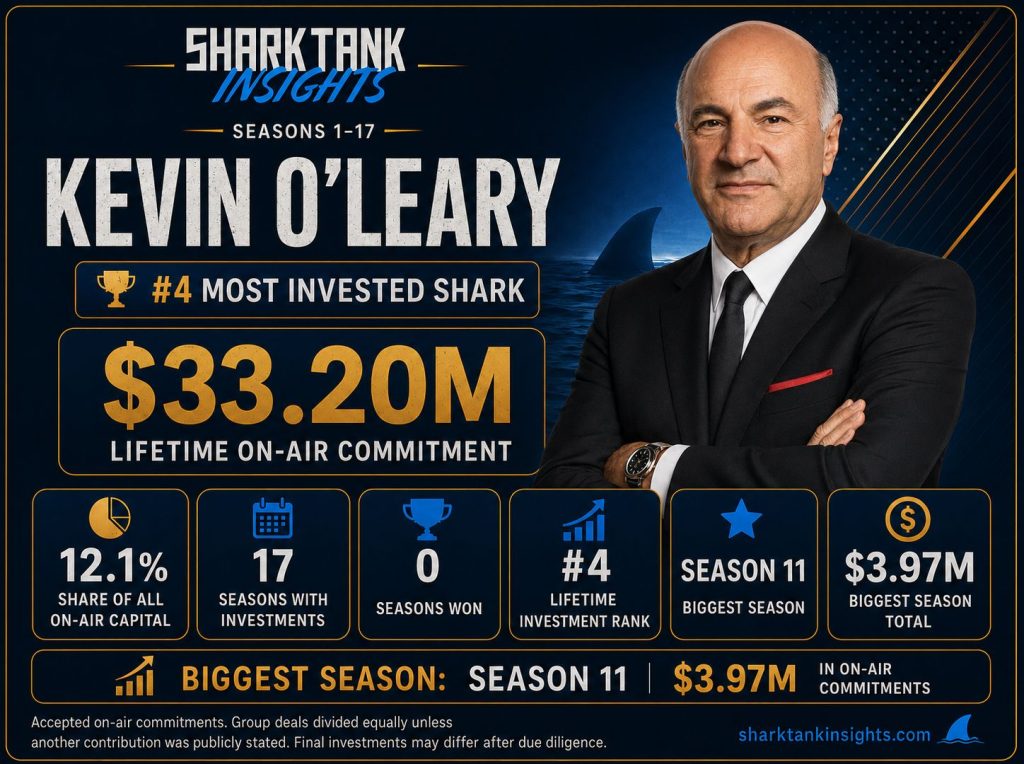
Kevin O’Leary ranks fourth with $33.20 million in accepted on-air financing. Surprisingly, Kevin never finished as the leading investor in an individual season, despite appearing throughout all 17 seasons.
However, he remained one of the show’s most consistent investors. His largest season was Season 11, when he committed $3.97 million. Kevin finished only about $31,667 behind Mark Cuban and $570,833 behind Lori Greiner that season.
Kevin O’Leary’s Investment Strategy
Kevin O’Leary is particularly known for:
- Royalty agreements
- Loans
- Credit facilities
- Licensing businesses
- High-margin products
- Companies with predictable cash flow
- Deals designed to return his money quickly
Royalty agreements are often unpopular with entrepreneurs because the payments can continue even after Kevin has recovered his original investment.
However, Kevin prefers these agreements because they can reduce risk and provide regular income without depending entirely on a future sale of the company.
Notable Kevin O’Leary Investments
Kevin’s portfolio includes:
- Basepaws: $250,000 shared with Robert Herjavec
- CertifiKID: $600,000
- Boost Oxygen: $1 million financing package
- Lovepop: $300,000
- Bertello: $120,000
- Zipz: $2.5 million
Zipz was one of the largest accepted offers in the history of the program. However, the company struggled to build a sustainable business and eventually stopped operating. The failure of Zipz shows that even a record-breaking television deal does not guarantee long-term success.
5. Barbara Corcoran — $23.36 Million
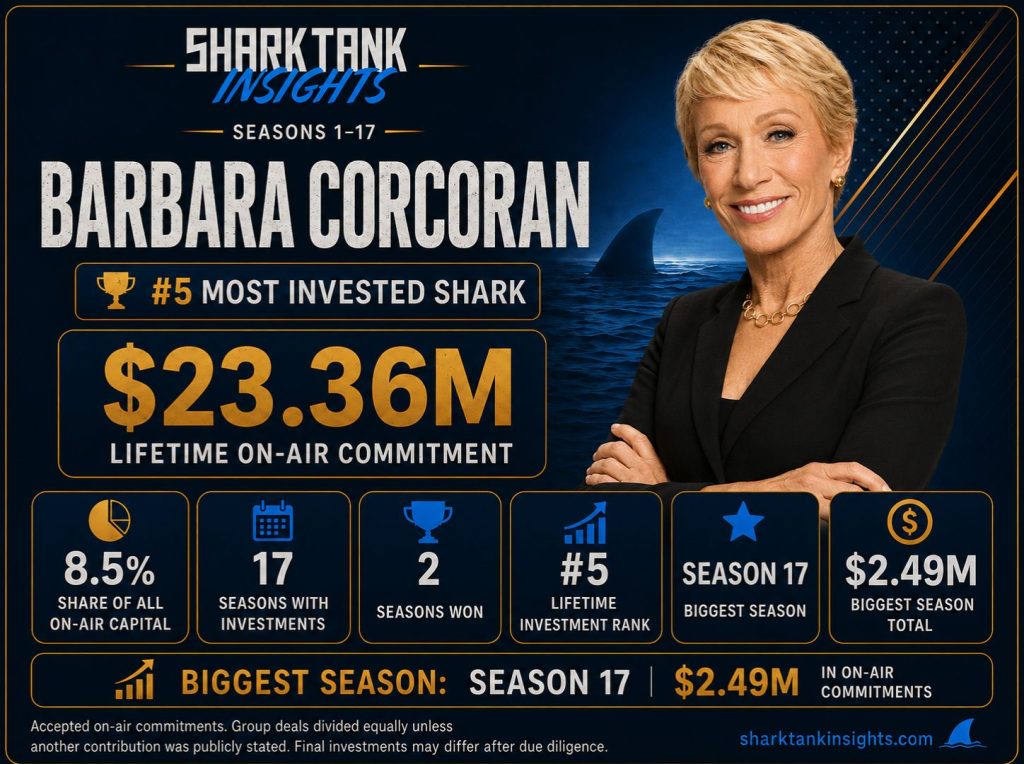
Barbara Corcoran ranks fifth with $23.36 million in accepted on-air commitments. She won the investment leaderboard during the first season and returned to the top again in Season 17.
Her Season 17 victory was particularly notable. Barbara committed $2.49 million, narrowly beating Lori Greiner’s $2.33 million. Barbara remained in first place even after removing the $125,000 operating credit line included in The Christmas Carolers agreement.
Barbara Corcoran’s Investment Style
Barbara often focuses more on the entrepreneur than the product. She normally prefers founders who demonstrate:
- Strong sales ability
- Resilience
- Personal motivation
- Coachability
- The ability to attract attention
- Determination after failure
Her experience in real estate also makes her comfortable with:
- Service companies
- Franchise businesses
- Local businesses
- Founder-led companies that can expand through multiple operators
Notable Barbara Corcoran Investments
Barbara’s most recognized portfolio companies include:
- The Original Comfy: $50,000 for 30%
- Cousins Maine Lobster: $55,000 for 15%
- Grace and Lace: $175,000 financing package
- Pork Barrel BBQ: Shared investment
- Villy Custom: Shared investment with Mark Cuban
The Original Comfy is an important example of how a small investment can produce one of the biggest company successes in the show’s history.
6. Daymond John — $22.30 Million
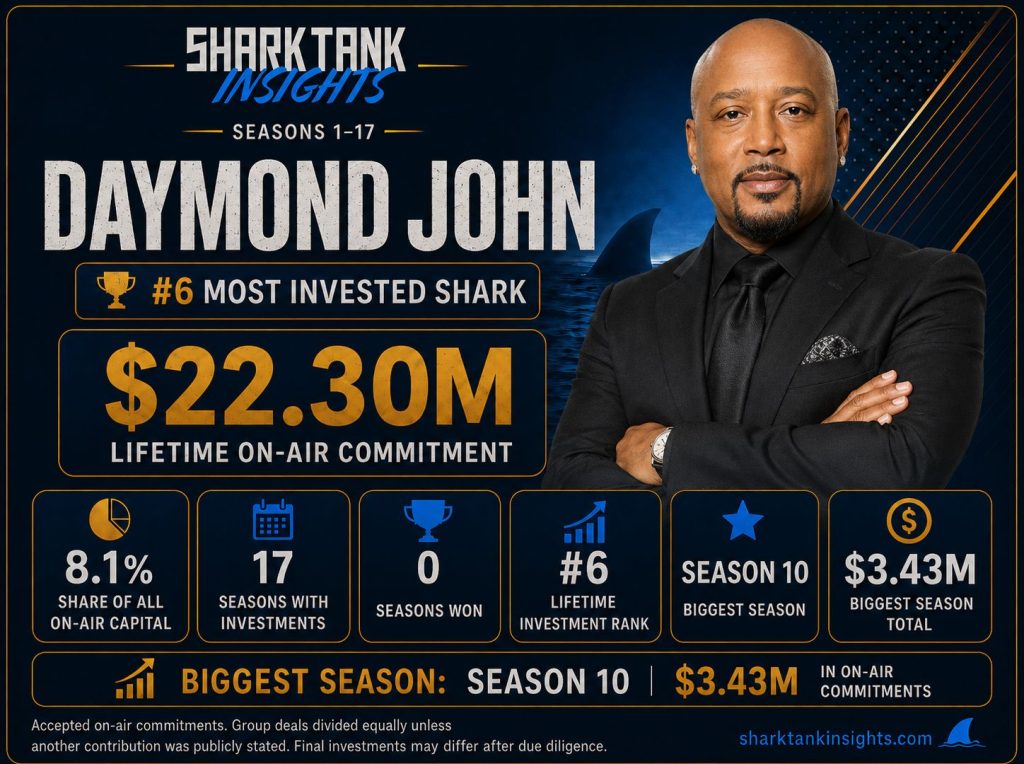
Daymond John ranks sixth among the long-serving Sharks with $22.30 million in accepted on-air commitments.
His total is only around $1.06 million lower than Barbara Corcoran’s. Therefore, the difference between fifth and sixth place is much smaller than the gap between the leading investors.
Daymond’s largest season was Season 10, when his attributed commitments reached $3.43 million.
However, $3 million of that amount came from his proposed acquisition of Moki Doorstep. The acquisition did not close after filming.
Daymond John’s Investment Strategy
As the founder of FUBU, Daymond has particular experience in:
- Fashion
- Apparel
- Consumer branding
- Licensing
- Retail distribution
- Celebrity partnerships
- Lifestyle companies
Daymond frequently talks about the “power of broke.” This means building a company through creativity, effort and resourcefulness rather than depending on unlimited money.
Notable Daymond John Investments
Daymond’s portfolio includes:
- Bombas: $200,000 for 17.5%
- Mission Belt: $50,000
- Bubba’s Q BBQ : $300,000
- SHEFIT: $250,000
- Sun-Staches: $300,000
- Mo’s Bows: Mentorship agreement
Bombas became the defining investment of Daymond’s Shark Tank career. It is also one of the most successful and recognizable companies ever featured on the program.
Which Other Prominent Sharks Invested The Most?
The six long-serving Sharks account for most of the financing announced on Shark Tank. However, several guest Sharks, former panelists and later additions also committed substantial amounts.
Daniel Lubetzky leads this group with $6.49 million in accepted on-air commitments. His total is more than twice the amount committed by Rohan Oza, who ranks second.
However, none of these investors finished as the overall investment leader of a complete season. Therefore, every investor in this group has zero season victories.
Lifetime Ranking Of Former, Guest And Later-Added Sharks
The remaining $34.75 million was committed by guest Sharks, former Sharks and later additions. The complete ranking is:
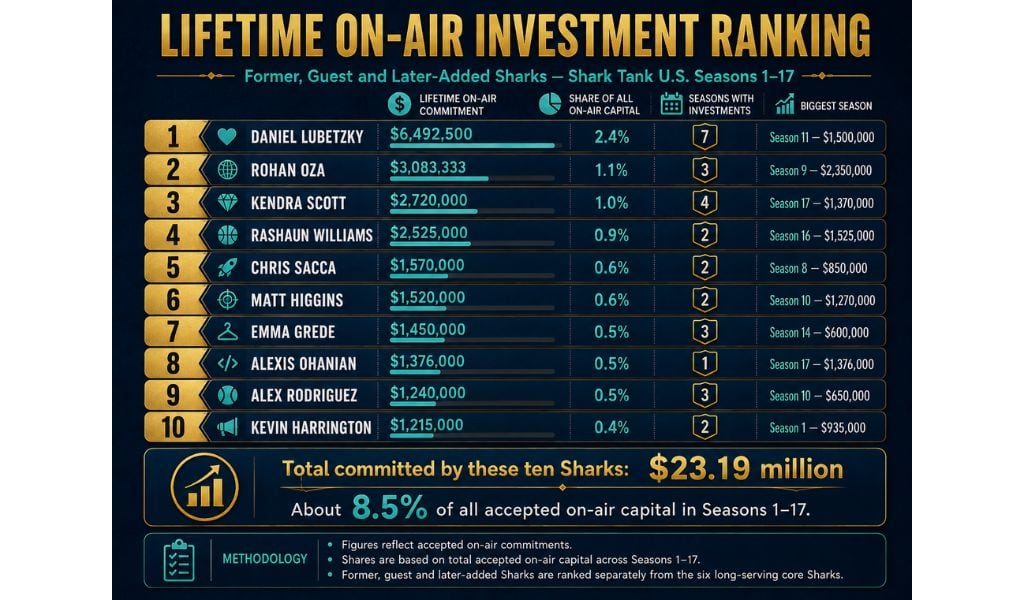
| Rank | Shark | Lifetime on-air commitment | Share |
|---|---|---|---|
| 7 | Daniel Lubetzky | $6,492,500 | 2.36% |
| 8 | Rohan Oza | $3,083,333 | 1.12% |
| 9 | Kendra Scott | $2,720,000 | 0.99% |
| 10 | Rashaun Williams | $2,525,000 | 0.92% |
| 11 | Chris Sacca | $1,570,000 | 0.57% |
| 12 | Matt Higgins | $1,520,000 | 0.55% |
| 13 | Emma Grede | $1,450,000 | 0.53% |
| 14 | Alexis Ohanian | $1,376,000 | 0.50% |
| 15 | Alex Rodriguez | $1,240,000 | 0.45% |
| 16 | Kevin Harrington | $1,215,000 | 0.44% |
| 17 | Michael Rubin | $975,000 | 0.35% |
| 18 | Tony Xu | $875,000 | 0.32% |
| 19 | Peter Jones | $800,000 | 0.29% |
| T-20 | Sara Blakely | $700,000 | 0.25% |
| T-20 | Todd Graves | $700,000 | 0.25% |
| 22 | Kevin Hart | $650,000 | 0.24% |
| 23 | Bethenny Frankel | $625,000 | 0.23% |
| T-24 | Jamie Siminoff | $500,000 | 0.18% |
| T-24 | Candace Nelson | $500,000 | 0.18% |
| T-26 | Maria Sharapova | $450,000 | 0.16% |
| T-26 | Jason Blum | $450,000 | 0.16% |
| 28 | Allison Ellsworth | $425,000 | 0.15% |
| 29 | Charles Barkley | $375,000 | 0.14% |
| 30 | Richard Branson | $360,000 | 0.13% |
| 31 | Chip & Joanna Gaines | $350,000 | 0.13% |
| 32 | Gwyneth Paltrow | $325,000 | 0.12% |
| 33 | Nirav Tolia | $300,000 | 0.11% |
| 34 | Fawn Weaver | $275,000 | 0.10% |
| 35 | Anne Wojcicki | $250,000 | 0.09% |
| 36 | Jamie Kern Lima | $233,333 | 0.08% |
| 37 | Michael Strahan | $225,000 | 0.08% |
| T-38 | Ashton Kutcher | $200,000 | 0.07% |
| T-38 | Katrina Lake | $200,000 | 0.07% |
| T-38 | Blake Mycoskie | $200,000 | 0.07% |
| 41 | John Paul DeJoria | $150,000 | 0.05% |
| T-42 | Nick Woodman | $125,000 | 0.05% |
| T-42 | Troy Carter | $125,000 | 0.05% |
| 44 | Alli Webb | $90,000 | 0.03% |
| 45 | Jeff Foxworthy | $75,000 | 0.03% |
| 46 | Steve Tisch | $50,000 | 0.02% |
Daniel Lubetzky — $6.49 Million
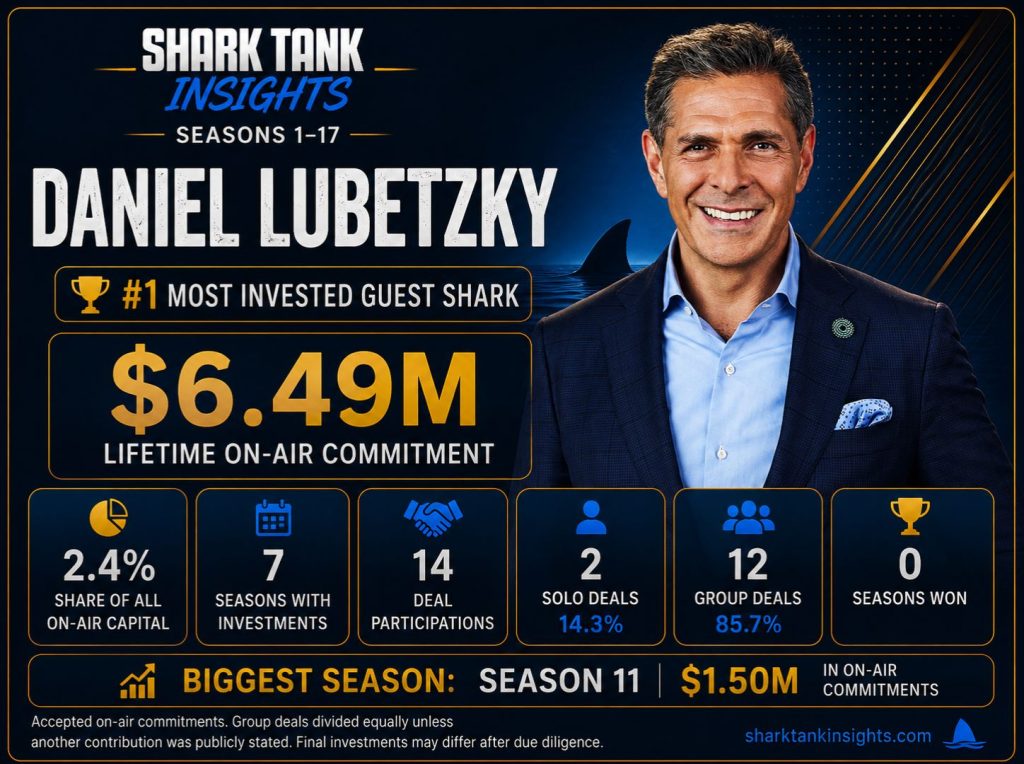
Daniel Lubetzky leads all former, guest and later-added Sharks with $6.49 million in accepted on-air commitments. He first appeared as a guest Shark before becoming a regular member of the panel during Season 16.
Daniel committed money during seven seasons, which is the highest number among the investors in this group. His biggest season was Season 11, when he committed $1.5 million. Most of that amount came from his $1 million Yellow Leaf Hammocks agreement.
Although Daniel was the leading guest investor during Season 11, he finished fifth in the complete season ranking. Lori Greiner won the season with $4.54 million.
Daniel normally invests in:
- Food and beverage companies
- Mission-driven businesses
- Consumer products
- Ethical brands
- Companies with a positive social purpose
His other accepted investments included TaDah, Quevos, Deux, FitFighter, Bleni Blends and several later-season businesses.
Daniel’s lifetime total places him far ahead of every other investor outside the six long-serving Sharks. However, his $6.49 million still represents only around 2.4% of all the money announced during the first 17 seasons.
Rohan Oza — $3.08 Million
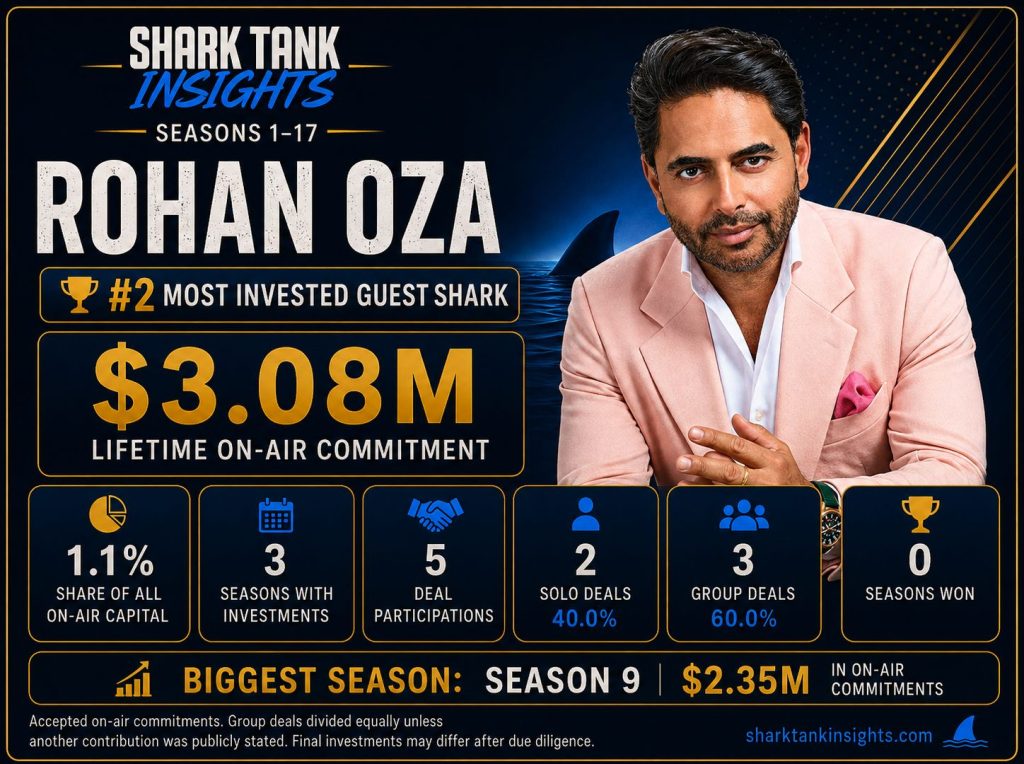
Rohan Oza ranks second among the additional Sharks with $3.08 million in accepted commitments. Most of his lifetime total came during Season 9, when he committed $2.35 million across three deals.
That single season represented 76% of all the money Rohan committed during his appearances. Despite the large amount, Rohan finished fourth in the Season 9 investment ranking. Mark Cuban won the season with $4.97 million.
Rohan is widely known for developing and promoting consumer brands. Therefore, his investments normally focus on:
- Food products
- Beverages
- Consumer brands
- Celebrity marketing
- Products with national retail potential
His most famous Shark Tank investment was Mother Beverage. The company later changed its name to Poppi and became a major prebiotic soda brand. Rohan also appeared during Seasons 10 and 11, but his investment totals during those seasons were much lower than his Season 9 commitment.
Kendra Scott — $2.72 Million
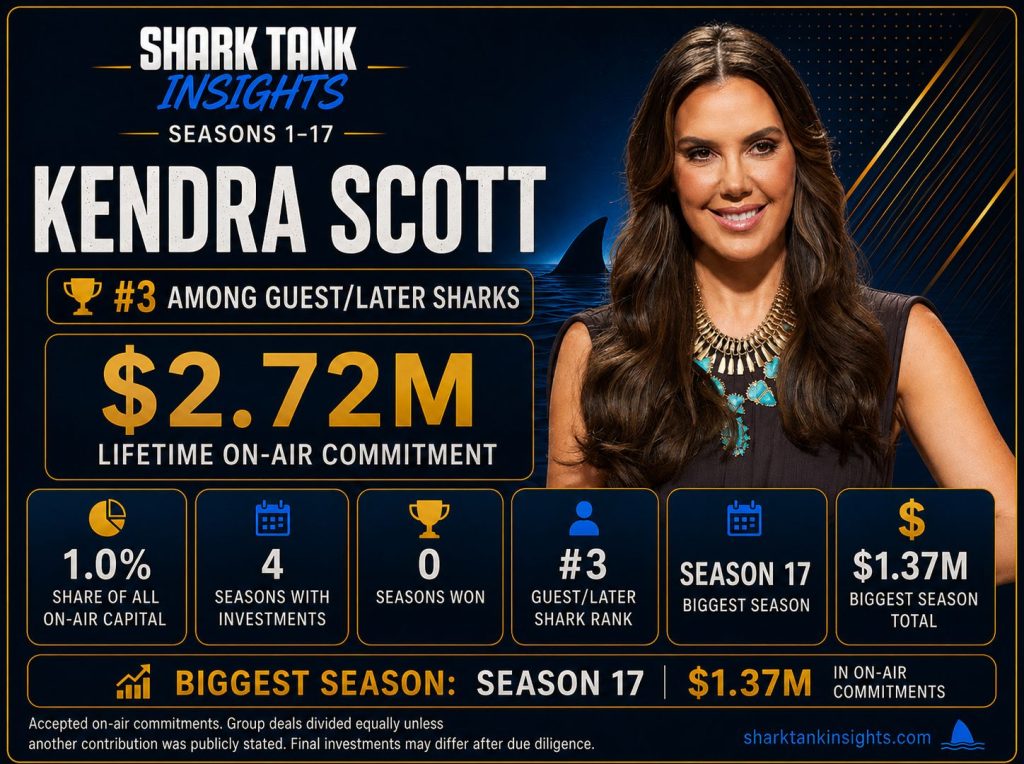
Kendra Scott ranks third with $2.72 million in accepted on-air commitments. She made investments during four seasons, with more than half of her lifetime total coming during Season 17.
Kendra committed $1.37 million across eight Season 17 deals, making her one of the most active investors of the season. However, Barbara Corcoran won the complete Season 17 investment ranking with $2.49 million.
Kendra normally focuses on:
- Fashion
- Jewelry
- Beauty products
- Retail businesses
- Consumer brands
- Companies led by founders with strong personal stories
Kendra also committed $750,000 during Season 12, $350,000 during Season 14 and $250,000 during Season 16. Her Season 17 performance significantly increased her lifetime ranking and moved her ahead of Rashaun Williams and Chris Sacca.
Rashaun Williams — $2.53 Million
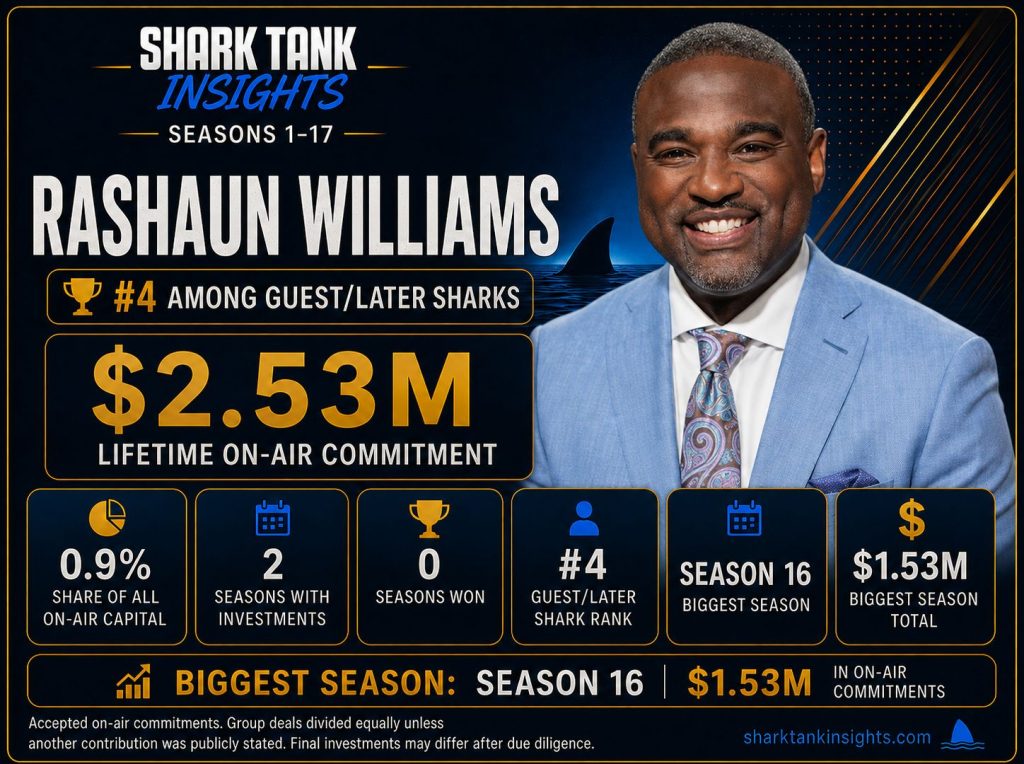
Rashaun Williams committed $2.53 million across Seasons 16 and 17. His biggest season was Season 16, when he committed $1.525 million across five accepted deals.
This placed him fourth in the complete Season 16 on-air ranking behind Lori Greiner, Mark Cuban and Barbara Corcoran. Rashaun also had one of the strongest post-show results during the season. Public evidence supported all five of his Season 16 commitments as completed or continuing.
His Season 16 investments included:
Rashaun added another $1 million during Season 17. His investment approach normally focuses on:
- Companies with large growth opportunities
- Strong financial potential
- Sports and fitness businesses
- Consumer brands
- Founders capable of building major companies
Although Rashaun appeared during only two seasons, he already ranks fourth among the prominent additional Sharks.
Chris Sacca — $1.57 Million
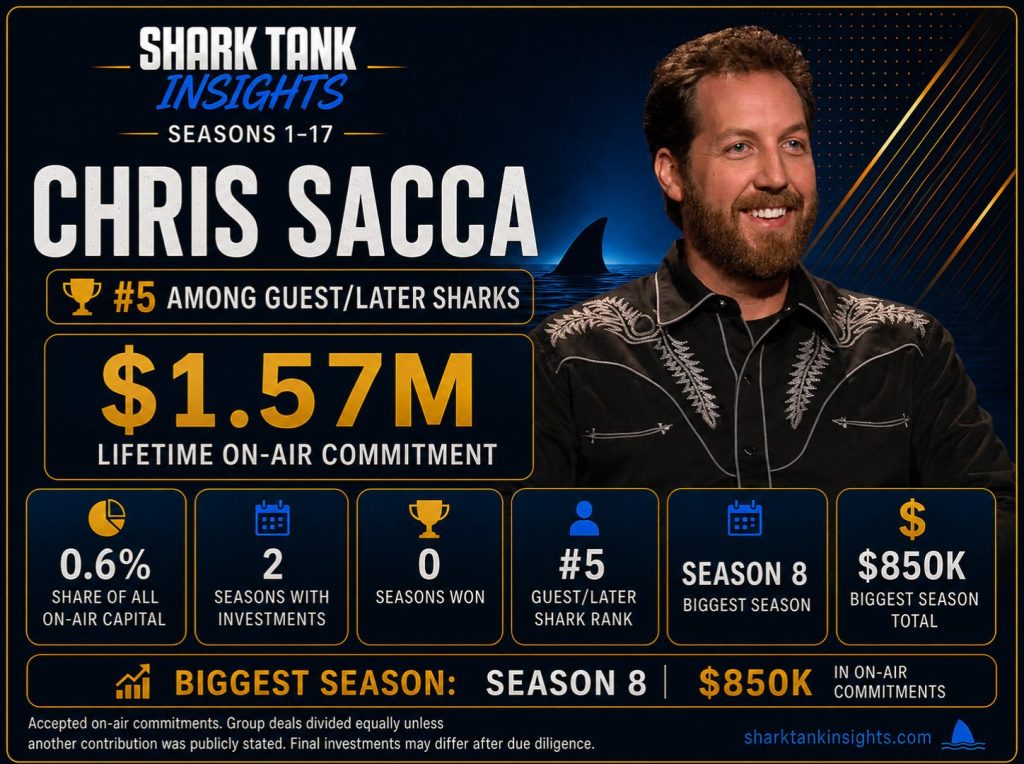
Chris Sacca committed $1.57 million across Seasons 7 and 8. His biggest season was Season 8, when he committed $850,000 across four accepted deals.
He finished seventh in that season’s investment ranking. Lori Greiner won the season with $5.23 million. Chris committed the remaining $720,000 during Season 7.
His Season 7 investments were particularly notable because the complete $720,000 was classified as confirmed funding under the season audit. This gave him a 100% publicly supported capital-conversion rate for the season.
His accepted investments included:
- Hatch Baby
- Rent Like a Champion
- Brightwheel
- Bee Free Honee
Chris came to the show with a strong background in technology investing. Therefore, he normally preferred:
- Software businesses
- Mobile applications
- Technology platforms
- Subscription companies
- Companies with rapid growth potential
Although he appeared during only two seasons, Chris became one of the most recognizable guest Sharks in the history of the program.
Matt Higgins — $1.52 Million
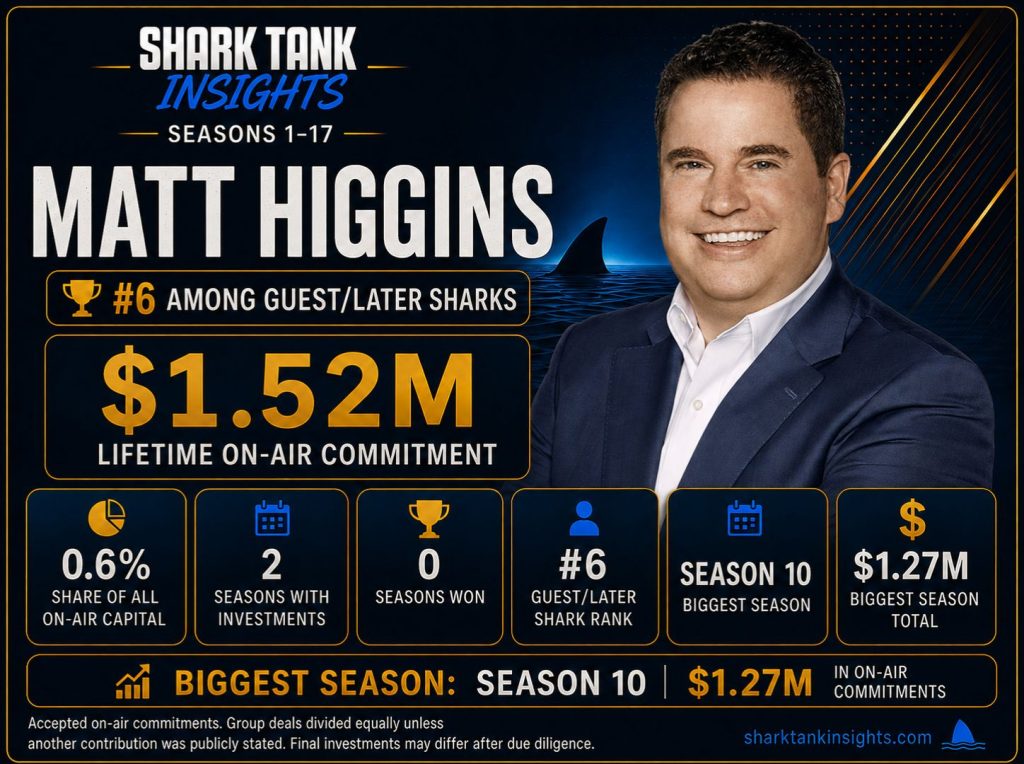
Matt Higgins committed $1.52 million during Seasons 10 and 11. His biggest season was Season 10, when he committed $1.27 million across three accepted deals.
This placed him sixth in the complete Season 10 investment ranking. Mark Cuban won that season with $5.43 million. Matt added another $250,000 during Season 11.
As an investor and sports-business executive, Matt normally focused on:
- Strong consumer brands
- Sports-related businesses
- Licensing opportunities
- Companies with expansion potential
- Founders capable of building national brands
Matt also participated in the Cup Board Pro agreement, when all five Sharks joined together to support the children of late firefighter Keith Young. The emotional nature of the pitch made Cup Board Pro one of the most memorable group deals in the program’s history.
Emma Grede — $1.45 Million
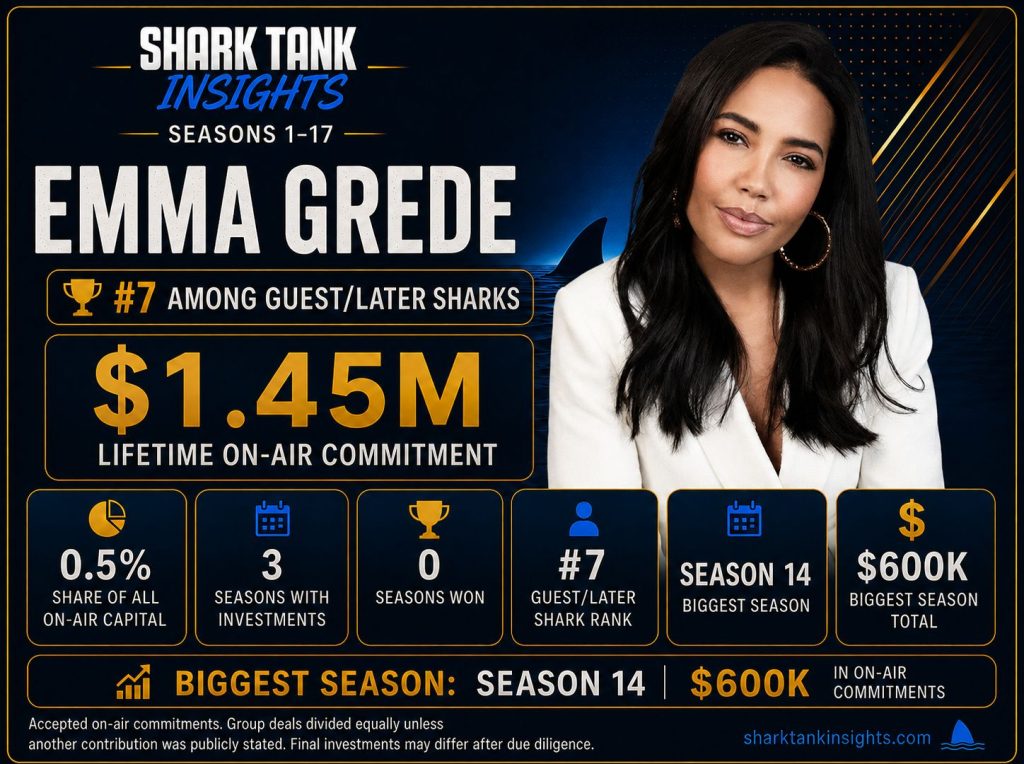
Emma Grede committed $1.45 million across Seasons 13, 14 and 15. Her biggest season was Season 14, when she committed $600,000 across two accepted deals.
This placed her second among the Season 14 guest Sharks, behind Tony Xu’s $875,000. Lori Greiner won the overall season with $3.89 million.
Emma’s biggest Season 14 investment was her $350,000 Kahawa 1893 agreement. The partnership later appeared in a follow-up update, supporting the conclusion that the deal proceeded. Emma committed $475,000 during Season 13 and another $375,000 during Season 15.
Her business experience with Good American and SKIMS makes her particularly interested in:
- Fashion
- Beauty
- E-commerce
- Inclusive consumer products
- Businesses founded by women
- Brands with strong marketing potential
Although Emma never led a full season, her $1.45 million lifetime total places her among the most active guest Sharks.
Alexis Ohanian — $1.38 Million
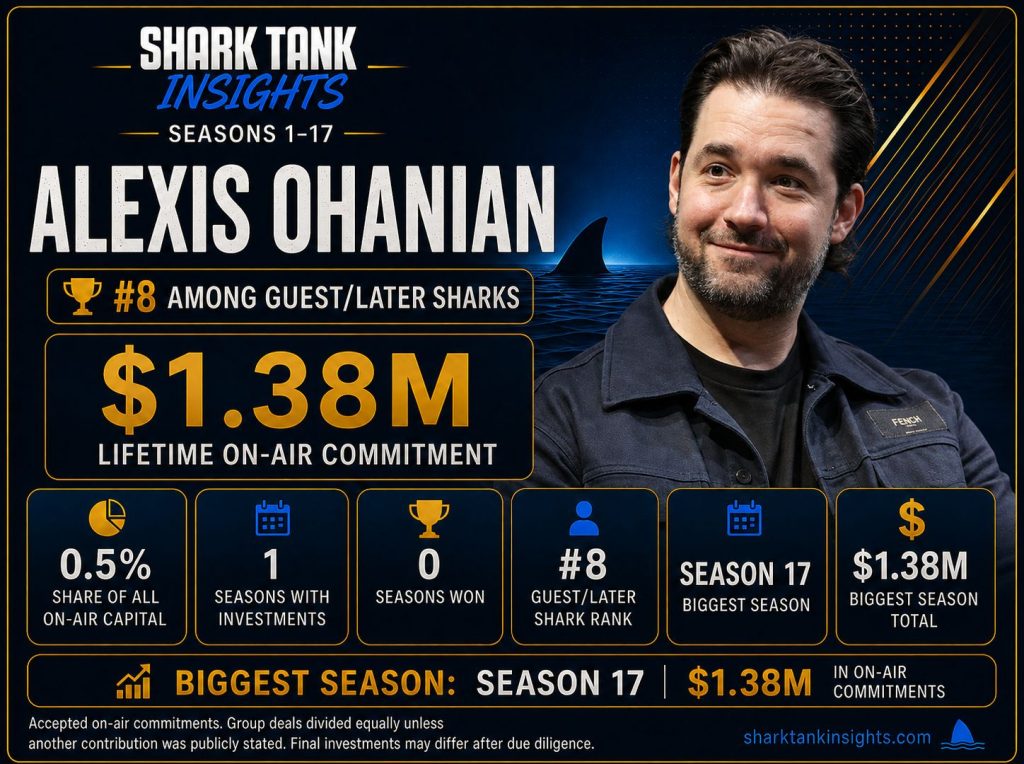
Alexis Ohanian committed $1.376 million across five Season 17 deals. Since Season 17 was his only season with accepted investments, his biggest-season total is also his complete lifetime total.
Alexis finished fourth in the overall Season 17 investment ranking and led all of the season’s guest Sharks. Barbara Corcoran won the complete season with $2.49 million.
Alexis’ largest agreement was his unusually specific $776,000 RetrievAir investment. His average commitment was $275,200 per deal, which was one of the highest averages recorded by any Season 17 investor.
As the co-founder of Reddit and a technology investor, Alexis normally focuses on:
- Technology companies
- Online communities
- Consumer platforms
- Businesses capable of rapid growth
- Founders building new categories
His $1.376 million total is particularly notable because he achieved it during only one season.
Alex Rodriguez — $1.24 Million
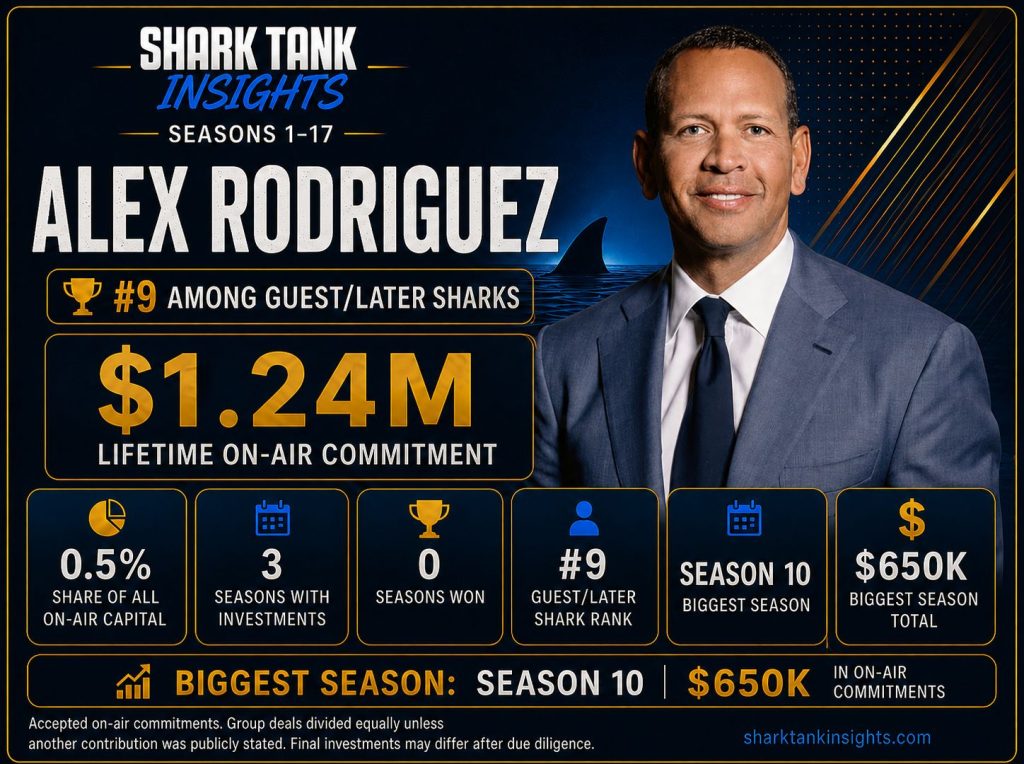
Alex Rodriguez committed $1.24 million during Seasons 9, 10 and 12. His biggest season was Season 10, when he committed $650,000 across two accepted deals.
He finished eighth in the complete season ranking. Mark Cuban won Season 10 with $5.43 million. Alex committed another $200,000 during Season 9 and $390,000 during Season 12.
His investment strategy normally focused on:
- Sports-related companies
- Health and fitness
- Consumer products
- Lifestyle brands
- Businesses that could benefit from celebrity marketing
Although Alex appeared across three seasons, none of his individual season totals exceeded $1 million.
Kevin Harrington — $1.22 Million
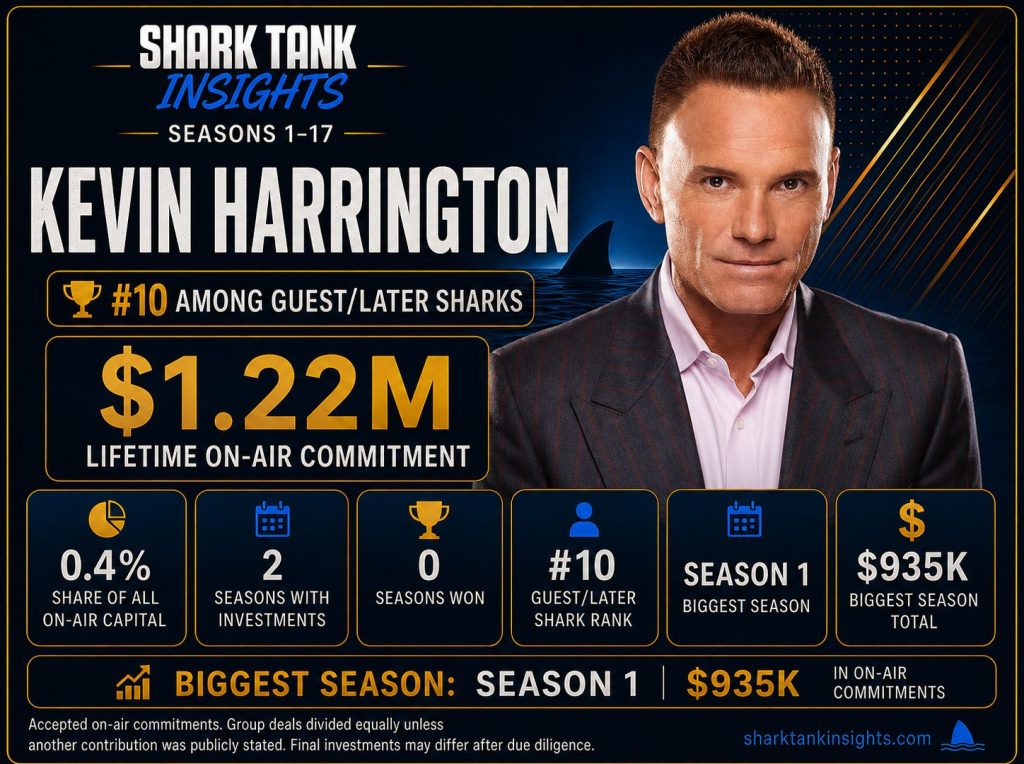
Kevin Harrington committed $1.22 million across the first two seasons. He was one of the five original Sharks and played an important role during the earliest period of the program.
His biggest season was Season 1, when he committed $935,000 across nine accepted deals. Kevin finished third in the Season 1 investment ranking behind Barbara Corcoran and Daymond John. He added another $280,000 during Season 2.
Kevin’s investment background was based heavily on infomercials and direct-response television. Therefore, he normally preferred:
- Products that were easy to demonstrate
- Consumer inventions
- Businesses suited to television advertising
- Products with mass-market appeal
- Companies that could scale through direct sales
One of his better-known early investments was CitiKitty, in which he invested $100,000. Kevin left the program after Season 2, which explains why his lifetime total is much lower than those of the other original Sharks.
Which Shark Won The Most Seasons?
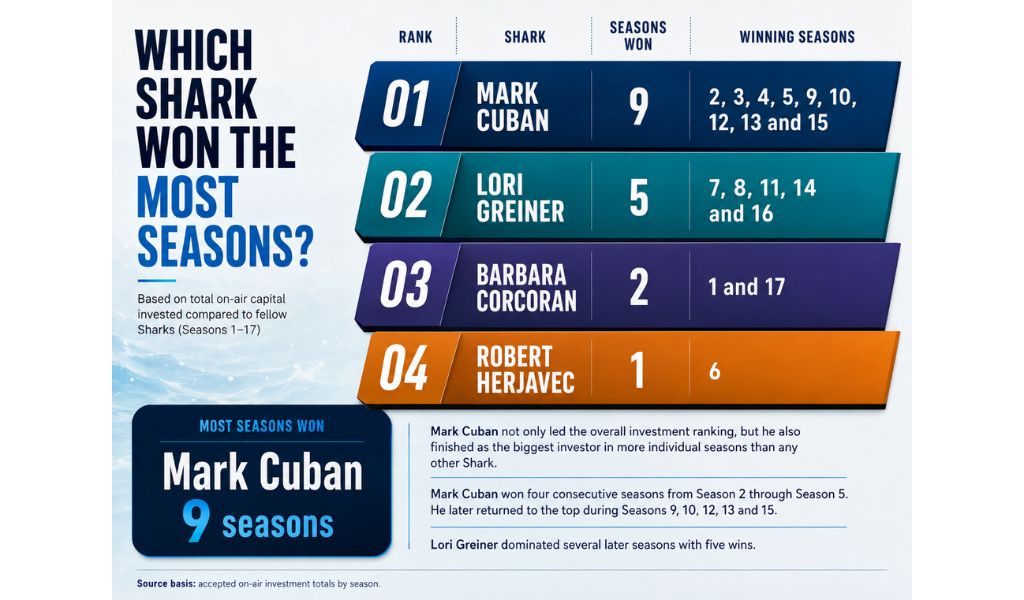
Mark Cuban not only led the overall investment ranking, but he also finished as the biggest investor in more individual seasons than any other Shark.
| Sharks | Seasons won | Winning seasons |
|---|---|---|
| Mark Cuban | 9 | 2, 3, 4, 5, 9, 10, 12, 13 and 15 |
| Lori Greiner | 5 | 7, 8, 11, 14 and 16 |
| Barbara Corcoran | 2 | 1 and 17 |
| Robert Herjavec | 1 | 6 |
Mark Cuban won four consecutive seasons from Season 2 through Season 5. He later returned to the top during Seasons 9, 10, 12, 13 and 15. Lori Greiner dominated several later seasons and became the only Shark who regularly challenged Cuban in both total capital and deal activity.
On-Air Commitments Are Not The Same As Actual Investments
One of the biggest problems with many Shark Tank investment rankings is that they describe every accepted television offer as a completed investment. This is not accurate.
After filming, the Shark normally reviews the company’s:
- Financial statements
- Sales records
- Debts
- Ownership structure
- Intellectual property
- Legal liabilities
- Supplier agreements
- Founder background
- Customer information
Once this process is complete, the agreement may close, change or disappear completely. Season 6 provides a good example.
The Sharks committed $26.18 million through accepted on-air deals. However, only around $12.69 million was classified as completed or materially restructured in the season audit.
Season 16 produced a stronger result. The Sharks committed $15.61 million, while around $10.62 million was publicly supported as completed or continuing.
Another $4.44 million remained unresolved when the season was verified. These examples show that there is no reliable universal failure percentage for all Shark Tank deals.
Therefore, the popular claim that exactly 73% of all deals fail should not be treated as a confirmed fact. The closing rate changes from one season to another, and many private companies never disclose the final terms of their agreements.
Who Actually Invested The Most After Due Diligence?
There is no official public record containing every final contract, revised valuation or transferred payment from all 17 seasons. Therefore, it is impossible to produce a completely accurate lifetime actual-investment ranking.
However, the available season data frequently places Mark Cuban at or near the top of publicly supported completed investment capital.
For example:
- Mark led Season 6 with an estimated $4.22 million in completed or restructured funding.
- He led Season 12 with at least $6.68 million in publicly supported actual investment.
- He led Season 16 with $2.48 million in supported completed or continuing investments.
This evidence suggests that Mark Cuban may also lead the lifetime actual-investment ranking.
However, the available information is not complete enough to calculate an exact total. The most accurate conclusion is:
Mark Cuban committed the most money through accepted on-air deals. He also appears to be the strongest candidate for the most completed investment capital, but no exact audited lifetime total is publicly available.
Final Words
Mark Cuban is the Shark who invested the most on Shark Tank, at least when investment is measured through accepted television commitments. His $67.81 million total gives him a substantial lead over Lori Greiner’s $54.46 million.
Cuban also won the season investment leaderboard nine times, which is nearly twice as many as Lori Greiner. However, the complete ranking shows that the history of Shark Tank investment is much broader than Mark Cuban and Lori Greiner.
Robert Herjavec committed more than $38.9 million, while Kevin O’Leary exceeded $33.1 million. Barbara Corcoran and Daymond John each committed more than $22 million. Daniel Lubetzky, Rohan Oza, Kendra Scott, Rashaun Williams, Chris Sacca and several other guest Sharks also made significant contributions.
The main lesson is that accepted on-air commitments and actual investments should never be treated as the same thing. The television figures show which Sharks were willing to offer the most money inside the Tank.
The post-show evidence tells a more complicated story involving due diligence, changed agreements and failed deals. Using the most consistent calculation method across the first 17 seasons, the final answer is clear:
Mark Cuban has committed the most money in Shark Tank history.

Hi. I’m Daniyal Durrani. A CA-finalist, CPA-UK, and Master in Economics, with a decade-long business studies experience. I work as an Audit and Business Advisory Manager in a globally recognized accounting firm. I have been watching Shark Tank for a long time and have always admired the innovative business ideas. The revolutionary solutions to unaddressed day-to-day problems presented on the show used to impress me like no other thing on TV. Read more About me.