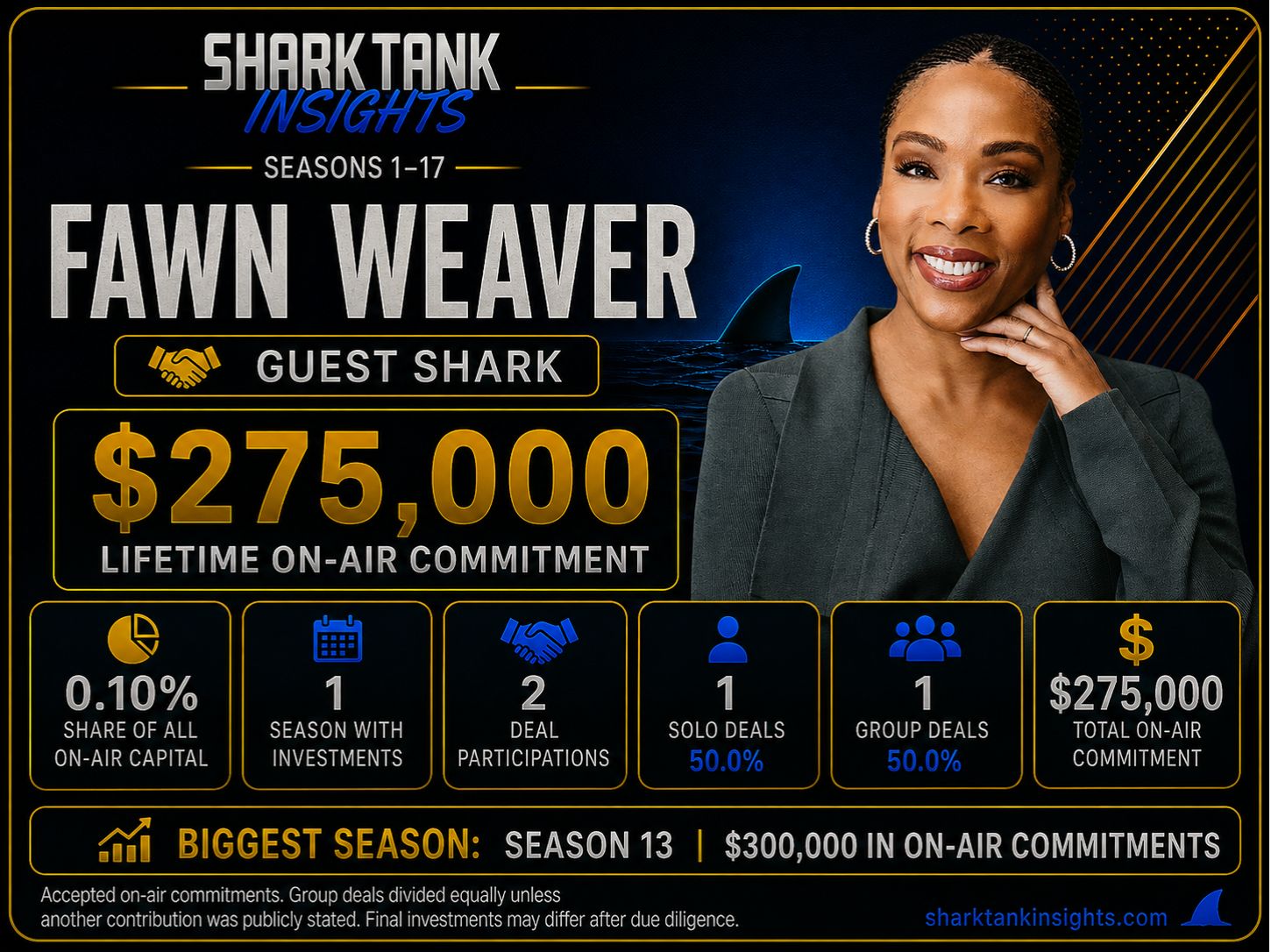
Fawn Weaver only had two chances to make a Shark Tank deal, and she made one both times. BRCĒ and Beer Girl were the two businesses she picked during Season 17. That leaves her with a pretty tiny list of companies, but not because she sat through a long run of episodes without investing. She simply was not there for very long.
BRCĒ and Beer Girl had almost nothing in common. BRCĒ was making performance shoelaces using its own material technology. Beer Girl was a lager business. Fawn had spent years building Uncle Nearest Premium Whiskey, so Beer Girl was much closer to something she already knew.
There was hardly much difference in the money either. Fawn’s part of the BRCĒ deal comes to $150,000 because Daniel Lubetzky shared the $300,000 investment with her. Beer Girl gave Fawn another $125,000, and she did that one alone. Just $25,000 separates the two, bringing everything she agreed to invest on Shark Tank to $275,000.
That $275,000 still comes with a question after filming. Beer Girl’s investment was reported as pending due diligence, while there is not enough public information showing the final BRCĒ paperwork and terms. Both businesses gave Fawn accepted deals on television. How much of the $275,000 actually went into them is not nearly as clear.
Fawn Weaver Shark Tank Investment Summary
Two accepted deals put $275,000 beside Fawn Weaver’s name. That is around 0.10% of the roughly $275.739 million entrepreneurs accepted in investment and financing through the first 17 seasons of Shark Tank. Of course, Fawn was only there for two episodes. There was not much opportunity for her number to become a large part of the show’s complete amount.
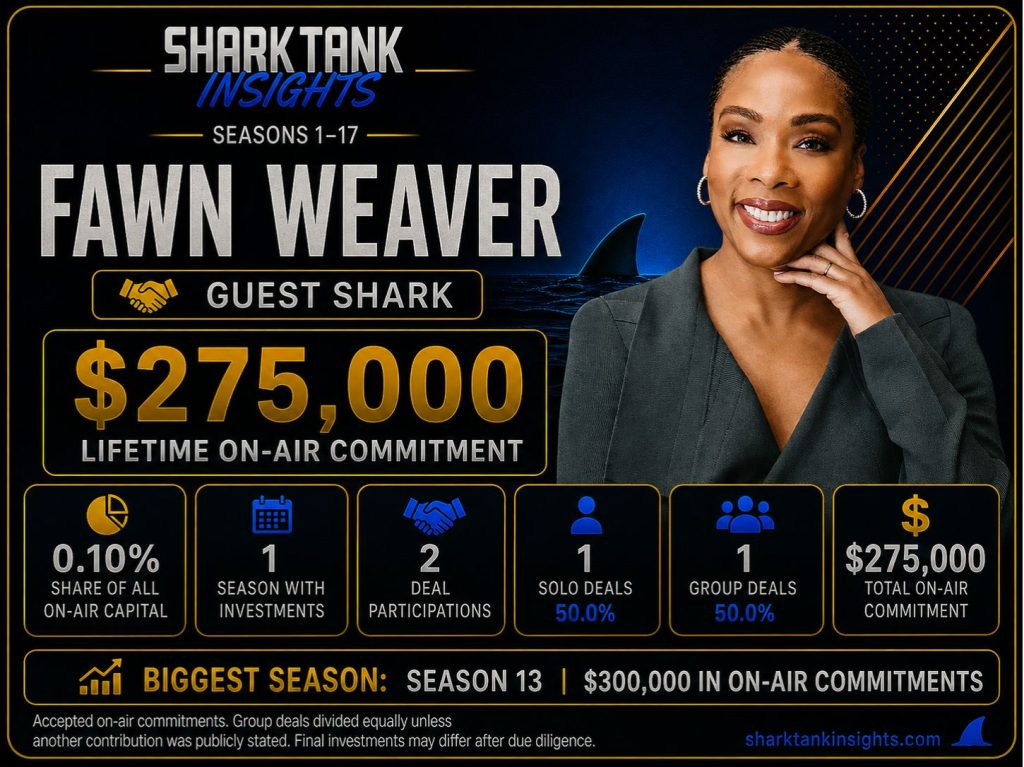
| Statistic | Fawn Weaver’s Record |
|---|---|
| Accepted on-air commitments | $275,000 |
| Share of total Shark Tank capital | Approximately 0.10% |
| Seasons with investments | 1 |
| Accepted-deal participations | 2 |
| Solo deals | 1 |
| Group deals | 1 |
| Largest attributed commitment | $150,000 – BRCĒ |
| Largest complete deal participated in | $300,000 – BRCĒ |
| Biggest season | Season 17 – $275,000 |
| Average commitment | $137,500 |
The $300,000 BRCĒ deal in the table is not all Fawn’s money. She made that agreement with Daniel Lubetzky, and there is no public information showing that they were putting in different amounts. Fawn’s side is therefore $150,000. Beer Girl adds the complete $125,000 because Fawn made that deal alone.
That also gives Fawn one solo deal and one deal with another Shark. Both happened in Season 17, so the same $275,000 is her biggest-season amount and her complete accepted amount. The average comes to $137,500 because there are only two investments to divide the money between. There really isn’t another season or a longer list of companies behind any of these numbers.
The $275,000 only tells us what Fawn agreed to invest on Shark Tank. Beer Girl was still going through due diligence after the episode, and BRCĒ has not made the final investment documents public. That leaves both deals without a clear final answer. We know the amount Fawn committed, but not exactly how much money she eventually invested.
Fawn Weaver’s Season 17 Investments
Season 17 did not give Fawn Weaver much time between her two deals. She made the first one with BRCĒ on March 4, 2026, and Beer Girl followed only two weeks later. Fawn’s Shark Tank investing ended with those two appearances. Both of her accepted deals came within the same two weeks in March.
The first appearance was also the only time another Shark invested with her. Fawn and Daniel Lubetzky agreed to $300,000 for 20% of BRCĒ, leaving $150,000 on Fawn’s side when the money is divided between them. Then she came back for Beer Girl and put up $125,000 for 20% by herself. Fawn had gone from sharing her first deal to taking the next one alone.
| Season | Fawn Weaver’s On-Air Commitment |
|---|---|
| Seasons 1–16 | $0 |
| Season 17 | $275,000 |
| Lifetime Total | $275,000 |
There cannot really be a bigger or smaller season in Fawn’s record. Season 17 is the only one with any money in it, so its $275,000 is also her complete amount. She appeared twice and came away with an accepted deal both times. For such a short Shark Tank stay, Fawn certainly managed to find businesses she wanted to put money behind.
Fawn Weaver’s BRCĒ Investment
Madhav Aggarwal and Tanvi Gadamsetti came to Shark Tank with BRCĒ, a performance shoelace they had developed while attending Michigan State University. Both founders had athletic backgrounds, so they knew how irritating it was when a shoelace came loose in the middle of an activity. Instead of stopping to tie it again and again, they wanted the lace to stay in place.
The founders did more than make the lace tighter. BRCĒ used its own polymer-composite material with Lattice Grip technology to give the shoelace more grip while someone was moving. So, the product looked like an ordinary part of a shoe, but there was quite a bit going on inside the material. The technology was really what made BRCĒ different from another company selling shoelaces.
And that is where BRCĒ could become more than what Madhav and Tanvi first put on someone’s shoes. The founders were already interested in finding other uses for the material, and after Shark Tank they continued talking about additional products and brand partnerships. A good shoelace can still be the first product without having to be the last one. There were other places the technology could possibly go.
Fawn Weaver joined Daniel Lubetzky on the investment. Together they offered $300,000 for 20%, and Madhav and Tanvi accepted the deal. With nothing showing a different cash split between the two Sharks, Fawn’s part comes to $150,000. It became the larger of her two accepted Shark Tank investments.
Did Fawn Weaver’s Shark Tank Deals Close?
BRCĒ gives us a little more to work with after Shark Tank. Madhav Aggarwal and Tanvi Gadamsetti continued mentioning Fawn Weaver and Daniel Lubetzky as part of the company, and Michigan State University later described the $300,000 as an investment the founders received. It does seem that Fawn and Daniel stayed involved with BRCĒ after filming. What is not public is the final agreement, so we do not know if the $300,000 for 20% deal went through without any changes.
Beer Girl is harder to answer. Brewbound reported that Fawn’s $125,000 deal was still going through due diligence after the episode. There has not been a later public confirmation saying that the investment was completed. That leaves Beer Girl’s deal without a definite ending for now.
And that leaves a little more uncertainty than we would like with only two companies. If one of these deals did not close, that would remove almost half of Fawn’s complete Shark Tank amount. She does not have another ten or twenty investments sitting behind them where one missing deal would hardly change anything.
For now, $275,000 is still the amount Fawn agreed to invest on Shark Tank. BRCĒ has better public evidence of continuing with its Sharks, while Beer Girl was last publicly reported as going through due diligence. Neither gives us enough to put a definite actual-investment number beside Fawn’s name.
Fawn Weaver’s Investment Style
Two deals are not really enough to give Fawn Weaver a fixed Shark Tank investment style. Beer Girl was in an industry she knew extremely well, while BRCĒ took her into performance shoelaces and material technology. If she had made another ten deals, maybe one kind of business would have started showing up again and again. With two, we just do not have that.
Beer Girl was much closer to the business Fawn already knew. She had spent years building Uncle Nearest, so she had already dealt with getting an alcohol brand noticed and getting it into stores. Caroline Renezeder Foulk was trying to do the same kind of thing with a new beer brand. Fawn already knew a lot of what Caroline would have to get through.
Then BRCĒ went in a completely different direction. Fawn did not have a shoelace background, but Madhav Aggarwal and Tanvi Gadamsetti had more than an ordinary lace because they had developed their own material technology. She was willing to go outside alcohol for that. And she was comfortable bringing Daniel Lubetzky into the deal with her.
So, Fawn’s two investments tell us more about what she was willing to consider than what she would always invest in. One was very familiar and one was not. One she did alone and one she shared. That is about as far as two Shark Tank deals can take us.
Who Is Fawn Weaver?
It took Fawn Weaver quite a while to get to whiskey. She had worked around public relations, restaurants and hospitality, and private investing became another part of her work through Grant Sidney, Inc. She was an author too. Happy Wives Club became a bestseller.
The whiskey part started with Nathan “Nearest” Green, and that is probably the more interesting part of how Uncle Nearest began. Fawn became interested in Green, a formerly enslaved distiller connected to the early history of Jack Daniel, and she started researching him and his family. There wasn’t an Uncle Nearest bottle at the beginning of all of this. Fawn was looking for more of Green’s story.
Uncle Nearest Premium Whiskey came later in 2017. Then the company started reaching a lot of places, eventually selling in all 50 states and international markets while Fawn developed a large distillery operation in Tennessee. Forbes valued Uncle Nearest at approximately $1.1 billion in 2024. That number is especially hard to miss considering the company had only launched seven years earlier.
Fawn had already done quite a bit before she came to Shark Tank Season 17. She had taken her research into Nearest Green and turned it into Uncle Nearest, a whiskey company Forbes valued at around $1.1 billion in 2024. And even Uncle Nearest was only one part of her business career.
What Happened to Fawn Weaver and Uncle Nearest?
Uncle Nearest was still making and selling whiskey while all of this was happening. Even after a federal judge placed the company into receivership in August 2025, the business did not shut down. But somebody else was now in charge of the business Fawn had spent years building. A court-appointed receiver had control instead of Fawn and Keith Weaver.
All of this involved more than $108 million in disputed loans. And Fawn did try to get some control over what happened next. In March 2026, she tried to put Uncle Nearest into Chapter 11 bankruptcy. The bankruptcy was dismissed because the receiver, not Fawn, had the authority to make that decision for the company.
Things went further after that. Court filings reported in July 2026 said Fawn and Keith’s employment and involvement with Uncle Nearest had ended effective June 1. They were not simply owners who had temporarily handed the day-to-day work to somebody else. Their involvement with the company had been terminated.
The receiver was also considering possible asset sales and even a sale of the main Uncle Nearest business. Uncle Nearest itself was still there and still operating. But Fawn was no longer controlling the company she had built. She was no longer working in it either.
Fawn Weaver Net Worth
Forbes put Fawn Weaver’s net worth at around $480 million in 2024. Uncle Nearest was worth approximately $1.1 billion at the time, and Fawn owned a large part of the company. So, quite a bit of that $480 million was sitting in what Uncle Nearest was worth. Once the value of that business changed, the old net worth number became much harder to use.
Fawn did not appear on the Forbes list in 2025. And after everything that happened with Uncle Nearest, using the old $480 million number for 2026 would be pretty difficult. The company went into receivership with more than $108 million in disputed loans, and the receiver was considering selling assets or even the main business. We simply don’t know what Fawn’s ownership is worth after all of that.
Uncle Nearest is not the only place Fawn has put her money either. She has other business interests and private investments through Grant Sidney, Inc. But there is no public value for all of those investments that could give us another number to use. For now, Fawn Weaver’s exact 2026 net worth is unknown.
Conclusion
Fawn Weaver’s two Shark Tank deals were still pretty new when everything around Uncle Nearest became much more complicated. She had agreed to $150,000 for her part of BRCĒ and $125,000 for Beer Girl, giving her $275,000 between the two. Both businesses continued after the show. But there still is not enough information to say what Fawn eventually invested in them or what she made.
Beer Girl was still going through due diligence, while what finally happened with the BRCĒ investment was never made public. So, we can say Fawn agreed to invest $275,000 on Shark Tank. We just cannot say that the complete $275,000 actually went into the two businesses.
Then there was Uncle Nearest. Fawn had built the company to around a $1.1 billion valuation by 2024, and Forbes put her own net worth at about $480 million that year.
Then Uncle Nearest went into receivership, and Fawn eventually was no longer controlling or working in the business. Even her old net worth number became difficult to use.
There are still a few numbers we cannot get to. Fawn agreed to invest $275,000 on Shark Tank, but we do not know how much she actually invested or made from those deals. And after everything that happened with Uncle Nearest, her current net worth is not clear either.

Hi. I’m Daniyal Durrani. A CA-finalist, CPA-UK, and Master in Economics, with a decade-long business studies experience. I work as an Audit and Business Advisory Manager in a globally recognized accounting firm. I have been watching Shark Tank for a long time and have always admired the innovative business ideas. The revolutionary solutions to unaddressed day-to-day problems presented on the show used to impress me like no other thing on TV. Read more About me.